Day Counting in Real Life: Deadlines, Notices, Countdowns and More
A practical guide to counting days in real life: deadlines, notice periods, countdowns, days left in the year, age in days, months to days and interest day counts, with worked examples.

Updated 16 min read

In this guide
- The short answer
- The rules at a glance
- Five steps to count any deadline
- How many days are left in the year?
- Counting down to a date
- How many days is six months?
- How many days old are you?
- Counting a 30 day notice
- How many days are in a year, month and week?
- Counting days for interest
- Calendar days vs business days
- Deadlines that land on a weekend
- Time zones and deadlines
- Counting backward
- Common mistakes
- Day counting terms
- Planning backward from a deadline
- Counting days in history
- Myths about counting days
- Three worked examples
- Teaching children to count days
- Countdowns to 2027 dates
- Date formats can trip you up
- Days or 24 hour periods?
- When the start date is unclear
- Counting days in the news and history
- Counting days for habits and streaks
- Counting days in recipes and gardening
- Counting days for pets
- The off by one problem
- A simple checklist
- Counting days in contracts
- Counting days for legal deadlines
- Counting days for money
- Counting days in sports and fitness
- Counting days between holidays
- Quick reference: days from a date
- Everyday periods and how they are counted
- Counting days at work
- Counting days for travel
- Counting days for health
- Long countdowns
- Counting days in school
- Inclusive or exclusive: worked examples
- Counting with a calendar
- Counting with a spreadsheet
- Counting across years
- Leap day birthdays and deadlines
- Why calculators beat mental math
- Frequently asked questions
- Count your days in seconds
Counting days sounds simple until it matters. How many days until a holiday, when a 30 day notice ends, how many days old you are, how long six months really is, or how a bank counts the days in an interest period: each one follows its own rule, and an off by one mistake can mean a missed deadline or a wrong payment.
This guide explains how to count days for deadlines, notices, countdowns and everyday questions, with clear rules and worked examples. For an exact answer in seconds, use our free days between dates calculator.
The short answer
- Countdowns: count from tomorrow up to and including the event day.
- Notice periods: usually start the day after notice is given.
- Legal and contract deadlines: usually exclude the first day and include the last.
- Months: never assume 30 days; months have 28 to 31 days.
- Years: 365 days, or 366 in a leap year.
- Business deadlines: check whether weekends and holidays count.
The rules at a glance
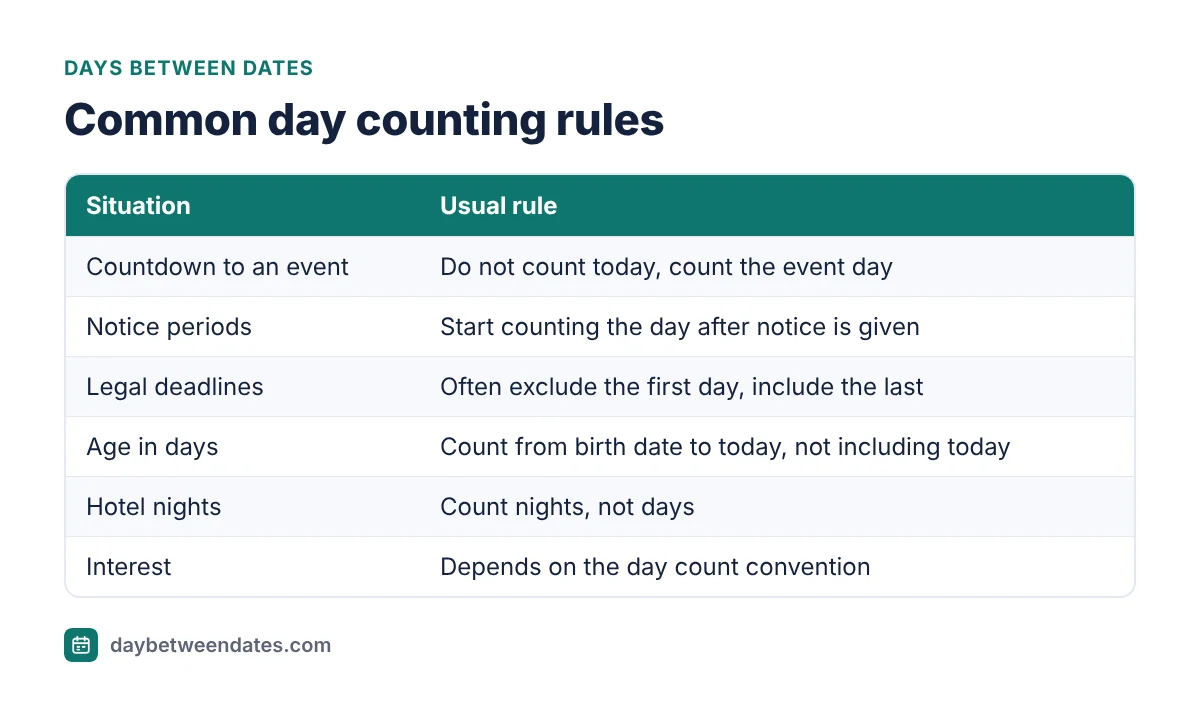
The most important question is always the same: is the first day counted? For a countdown, today is usually not counted, because the day has already started. For an inclusive period, such as a hotel stay or a course that runs "from Monday to Friday", both ends may count. Our guide to inclusive vs exclusive day counts explains the difference in detail.
Five steps to count any deadline
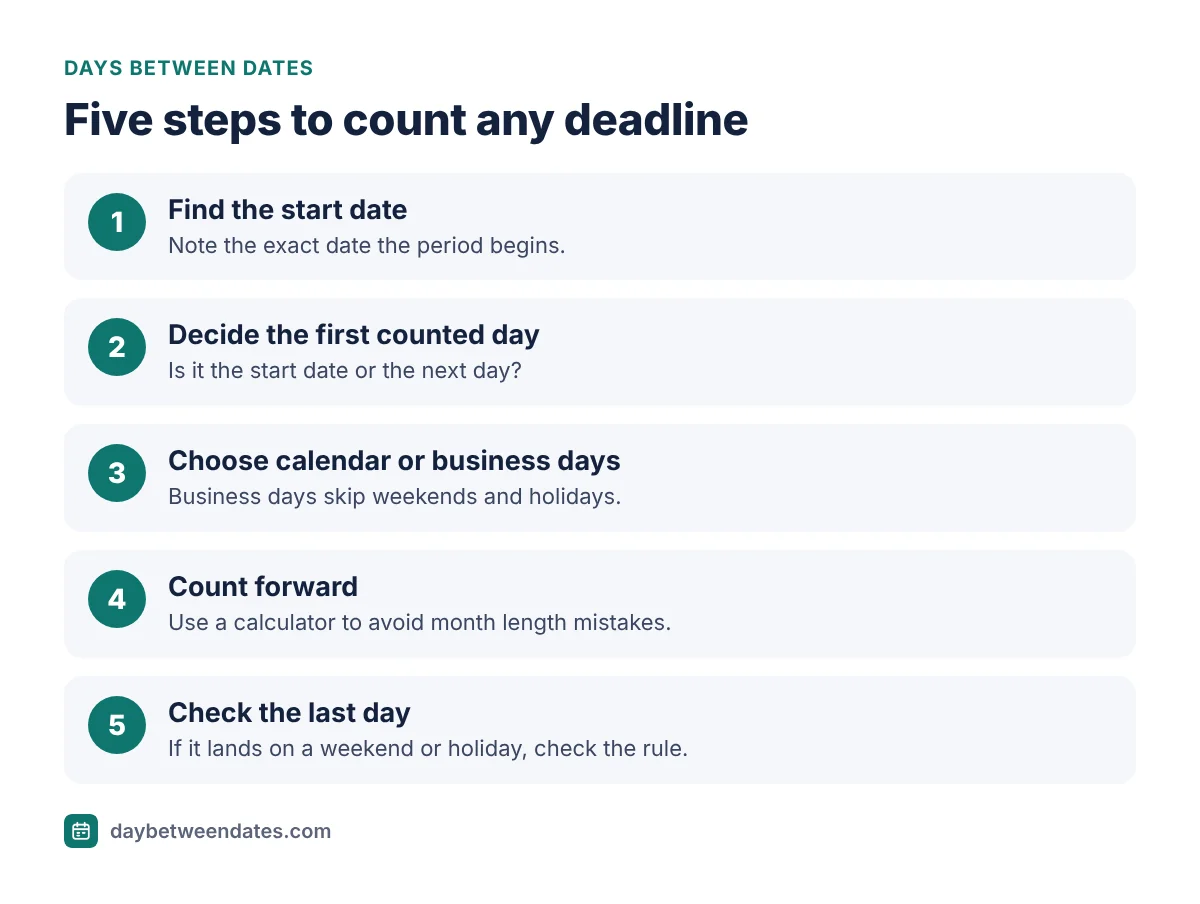
- Find the start date. Write down the exact date, and the time if it matters.
- Decide which day is day one. In most deadlines, the day of the event or the notice is day zero and the next day is day one.
- Choose calendar days or business days. Calendar days include weekends and holidays; business days do not. See business days vs calendar days.
- Count forward. A calculator avoids mistakes with month lengths and leap years.
- Check the final day. Many laws and contracts move a deadline that falls on a weekend or public holiday to the next working day.
How many days are left in the year?
On any date, the days left in the year are the days from tomorrow through December 31. On November 28, 2026, which is day 332 of the year, there are 33 days left in 2026, or 34 if you count today. In a leap year, the year has 366 days, so the count for dates after February 28 is one higher than in a normal year.
Read how many days are left in the year for a month by month table.
Counting down to a date
A countdown tells you how many days remain until an event, such as a birthday, a holiday, a wedding or a trip. From November 28, 2026, there are 27 days until Christmas on December 25, and 34 days until New Year's Day 2027. The usual rule is to count every day after today up to and including the event day.
See how to count down to any date for more examples and tips.
How many days is six months?
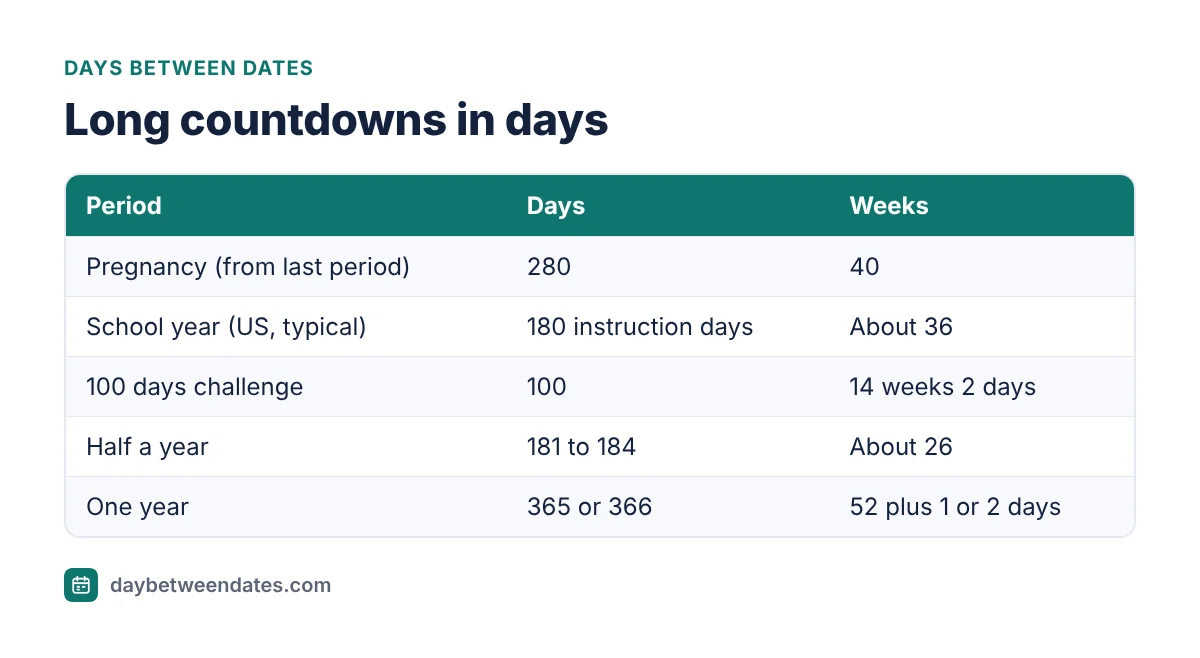
Six months is not a fixed number of days. Depending on the months included, it is 181 to 184 days. January to June 2027 is 181 days, while July to December 2027 is 184 days. That difference matters for leases, probation periods, visa rules and medical schedules.

Read how many days is 6 months for more spans.
How many days old are you?
Your age in days is the number of days from your birth date to today. Someone born on January 1, 2000 was 9,828 days old on November 28, 2026. Milestones such as 10,000 days old, which falls at about 27 years and 4 months, are popular to celebrate.
See how to calculate your age in days.
Counting a 30 day notice
A 30 day notice is common for rentals, jobs and contracts. In most cases, the 30 days start the day after notice is given. If notice is given on November 1, day one is November 2 and day 30 is December 1. Some contracts or local laws use other rules, such as requiring notice by a certain day of the month, so always read the wording.
Our guide to the 30 day notice covers rentals, jobs and common mistakes.
How many days are in a year, month and week?
- A week: 7 days.
- A month: 28, 29, 30 or 31 days.
- A common year: 365 days, or 52 weeks and 1 day.
- A leap year: 366 days, or 52 weeks and 2 days.
- An average Gregorian year: 365.2425 days.
See how many days are in a year, month and week, and our guide to leap years.
Counting days for interest
Banks and investors do not always count days the way the calendar does. A day count convention decides how many days are in an interest period and in a year. Under Actual/365, interest on 10,000 at 5% for 92 days is about 126.03. Under Actual/360, the same period earns about 127.78, because the year is treated as 360 days. Under 30/360, every month counts as 30 days.
Read day count conventions for interest.
Calendar days vs business days
Many everyday deadlines are set in business days: shipping times, bank transfers, government replies and some contract terms. A business day is usually Monday to Friday, excluding public holidays. Ten business days usually take two full weeks on the calendar, and longer around holidays.
For business day counts, read business days between two dates and how long 3 to 5 business days really is.
Deadlines that land on a weekend
What happens when the last day falls on a Saturday, Sunday or holiday depends on the rule that applies:
- Many court and government deadlines move to the next business day.
- Many contracts say so explicitly, but some do not.
- Personal deadlines, such as a countdown, simply stay on the calendar date.
When a lot is at stake, do not rely on the weekend rule: act before the deadline.
Time zones and deadlines
A deadline of "11:59 pm on March 31" means different moments in New York and London. For online applications, international contracts and remote work, check which time zone the deadline uses. If it is not stated, the safest assumption is the time zone of the organization that set it.
Counting backward
Some questions run the other way: what date was 90 days ago, or when should a 45 day process start to finish by a given date? Counting backward follows the same rules in reverse. Read what was 90 days ago and what date is 30, 60 or 90 days from today.
Common mistakes

The most common mistake is counting both the first and last day when only one should count. The second is assuming that every month has 30 days. Both lead to answers that are one or two days off, which is enough to miss a deadline.
Day counting terms
- Calendar day: any day, including weekends and holidays.
- Business day: usually Monday to Friday, excluding public holidays.
- Inclusive count: both the first and last day are counted.
- Exclusive count: the first day is not counted.
- Day of the year: a day's position from 1 to 365 or 366.
- Leap day: February 29, added in leap years.
- Day count convention: the rule a lender uses to count days for interest.
- Grace period: extra days after a due date before a penalty applies.
Planning backward from a deadline
Good planning often starts at the deadline and works backward. If a document must arrive by June 30 and mail takes 5 business days, it should be posted by June 23 at the latest. If it also needs a signature that takes a week to collect, the paperwork must start around June 14. Write each step on a calendar with its own date, and add a few spare days at the end in case something is late.
Counting days in history
Counting days far into the past has a twist: the calendar itself changed. When the Gregorian calendar was introduced in 1582, ten days were dropped, so October 4 was followed by October 15 in the countries that switched. Britain and its American colonies switched in 1752 and skipped eleven days: September 2 was followed by September 14. Day counts that cross these dates need a calculator that knows which calendar applies. For modern dates, this is never an issue.
Myths about counting days
- "A month is always 30 days." Only four months have 30 days.
- "Two weeks is always 14 business days." Two weeks contain 10 business days.
- "Every fourth year is a leap year." Not always: 1900 was not a leap year, but 2000 was.
- "If I count both dates, I am being safe." Counting extra days can make you miss a deadline by one day.
- "Deadlines always move to Monday." Only when the rule says so.
Three worked examples
Example 1: a 45 day deadline
You receive a letter dated Friday, March 5, 2027 that gives you 45 days to respond. Day one is March 6. Counting forward, day 45 is Monday, April 19, 2027. Because it falls on a weekday, no weekend rule applies. To be safe, send your reply a few days earlier.
Example 2: a 14 day return
You buy a gift on Thursday, December 10, 2026 with a 14 day return window. Day 14 is Thursday, December 24, Christmas Eve, when many stores close early. If the store does not extend its holiday returns, you would need to return the item by that afternoon.
Example 3: a 90 day probation
A new job starts on Wednesday, January 20, 2027 with a 90 day probation period. Counting the start date as day zero, day 90 is Tuesday, April 20, 2027. If the contract says "three months" instead, the end date would be April 20 as well in this case, but the two methods can differ by a day or two in other months.
Teaching children to count days
Children often learn day counting with an advent calendar, a paper chain or a marker on a wall calendar. Each morning, they cross off or remove one item, and the remaining items show the days to go. It is a simple way to show that today is not counted once it has started, and that the last item is the special day itself.
Countdowns to 2027 dates
Counting from Saturday, November 28, 2026:
| Event | Date | Days to go |
|---|---|---|
| Valentine's Day | Sunday, February 14, 2027 | 78 |
| Easter Sunday | March 28, 2027 | 120 |
| Mother's Day (US) | Sunday, May 9, 2027 | 162 |
| Halloween | Sunday, October 31, 2027 | 337 |
| Thanksgiving (US) | Thursday, November 25, 2027 | 362 |
| Christmas | Saturday, December 25, 2027 | 392 |
Date formats can trip you up
The date 03/04/2027 means March 4 in the United States but 3 April in the UK and most of the world. When you share or receive deadlines across countries, write the month as a word, such as 4 March 2027, or use the international format 2027-03-04. A misread date can shift a deadline by weeks.
Days or 24 hour periods?
Some periods are counted in hours rather than calendar days. A "48 hour" return window that starts at 3 pm on Monday ends at 3 pm on Wednesday, not at midnight. Car rentals, parking, hotel check out times, online auctions and some legal notices work this way. If a time is mentioned, count in hours from that time.
When the start date is unclear
Sometimes the start of a period is not obvious: does a 30 day period start when a letter is sent, when it is delivered, or when it is read? Many rules use the delivery date, and some add a few days for mail. Electronic notices often count from the time they are sent. If the start date is not defined, keep proof of when you sent and received each document.
Counting days in the news and history
Day counts also appear in history and the news: the first 100 days of a new government, the days since a record, or a 1,000 day anniversary. These counts usually include the first day. The "first 100 days" of a US president, for example, starts on Inauguration Day, January 20, so day 100 falls on April 29.
Counting days for habits and streaks
Apps that track streaks count consecutive days on which you completed a habit. Most reset to zero when you miss a day, although some allow a "freeze". If you track a habit on paper, mark each completed day and count the unbroken run back from today.
Counting days in recipes and gardening
- Fermentation and pickling: many recipes count from the day you start, with day one being the first full day.
- Seeds: packets list "days to germination" and "days to harvest", counted from sowing.
- Last frost dates: gardeners count back from the expected last frost to time indoor seed starting, for example 6 to 8 weeks before.
Counting days for pets
Puppy vaccinations, flea treatments and medicine for pets are usually timed in days or weeks. A treatment "every 30 days" is not the same as "monthly": over a year, every 30 days gives 12 doses plus a few days, while monthly gives exactly 12.
The off by one problem
Almost every day counting mistake is an off by one error. It happens when people count fence posts instead of the gaps between them. If you put a post at day 0 and another at day 10, there are 10 gaps but 11 posts. Days between dates count the gaps; inclusive day counts count the posts. Decide which one your question needs and the answer will be right.
A simple checklist
Before you rely on a day count, check:
- Did I use the right start date?
- Is the start date day zero or day one?
- Should the end date be included?
- Are these calendar days or business days?
- Does the period cross a month end, a leap day or New Year?
- What happens if the last day is a weekend or holiday?
- Which time zone does the deadline use?
If you can answer all seven, your count is solid.
Counting days in contracts
Contracts often use phrases that sound alike but count differently:
- "Within 30 days of" usually means on or before day 30 after the event.
- "After 30 days" usually means from day 31 onward.
- "Not less than 30 days' notice" means at least 30 full days must pass between the notice and the effective date.
- "By the 15th" usually includes the 15th itself.
- "Business days" usually excludes weekends and public holidays where the contract is governed.
When the wording is unclear, ask the other side to confirm the exact end date in writing. A single confirmed date avoids most disputes.
Counting days for legal deadlines
Courts and government agencies usually publish their own counting rules. A common approach in many US courts is to exclude the day of the event that starts the period, count every day including weekends and holidays, and include the last day unless it falls on a weekend or legal holiday, in which case the period runs to the end of the next business day. Rules differ by court, agency and country, and missing a legal deadline can have serious consequences, so check the exact rule or ask a lawyer.
Counting days for money
Money and day counts go together:
- Late fees: often charged once a payment is a set number of days late.
- Interest: charged per day on many loans and credit cards, using a daily rate.
- Early payment discounts: terms like "2/10, net 30" mean a 2% discount if you pay within 10 days, with the full amount due in 30 days.
- Billing cycles: credit card statements usually cover about 28 to 31 days.
A daily interest rate is the annual rate divided by 365 (or 360). At 20% a year, one day of interest on 1,000 is about 0.55.
Counting days in sports and fitness
Training plans are usually counted in days and weeks: a 12 week program is 84 days, a 30 day challenge is a month of daily sessions, and rest days count as part of the plan. When you miss a day, most plans recommend continuing from where you left off rather than squeezing two days into one.
Counting days between holidays
Holidays that fall on fixed dates, like Christmas on December 25, are easy to count to. Holidays that move, such as Thanksgiving on the fourth Thursday of November or Easter, need a calendar for each year. Our guide to US federal holidays lists the dates for the coming year.
Quick reference: days from a date
- 7 days: the same weekday next week.
- 14 days: the same weekday two weeks later.
- 28 days: four weeks later, always the same weekday.
- 30 days: two days later in the week than the start, in most cases.
- 90 days: about three months later.
- 365 days: one weekday later next year, or two if a leap day is crossed.
For exact dates, read what date is 30, 60 or 90 days from today.
Everyday periods and how they are counted
Return windows
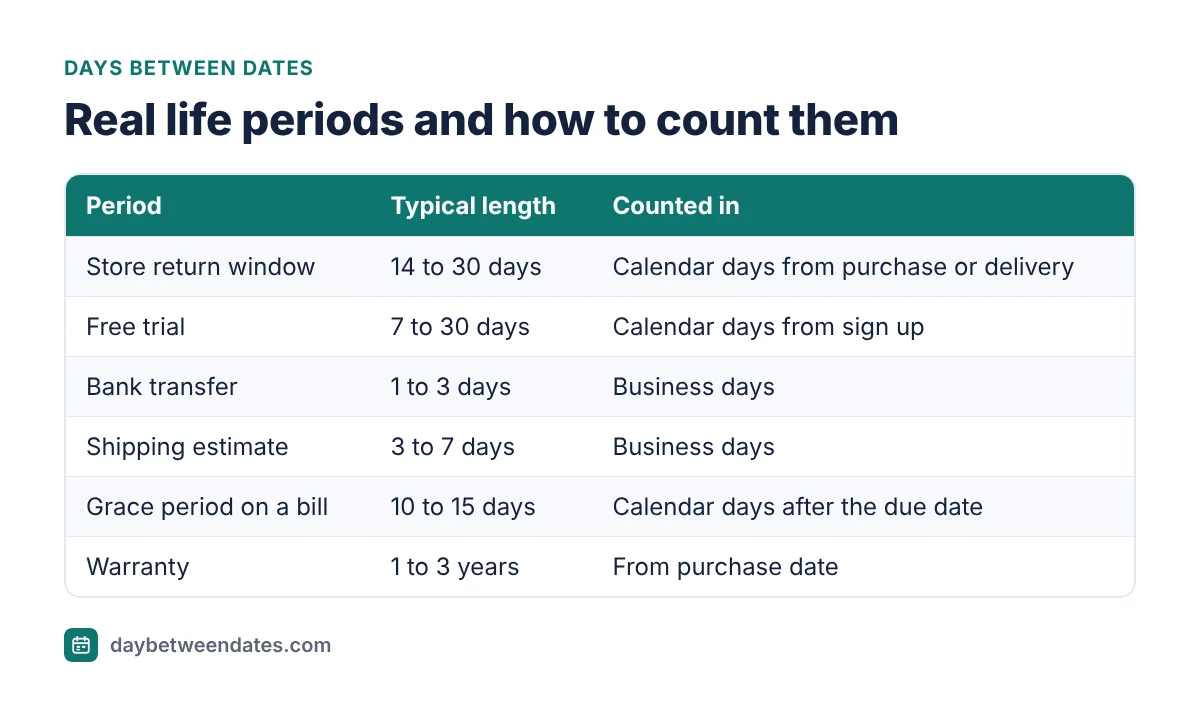
A "30 day return policy" usually counts calendar days from the date of purchase, or from delivery for online orders. If you bought something on November 28, the 30th day is December 28. Many stores extend return windows during the holiday season, but only if they say so.
Free trials
Free trials are counted from the moment you sign up, and many renew automatically at the end. A 7 day trial started on a Monday often ends on the following Monday at the same time. Set a reminder a day or two before the end if you do not want to be charged.
Bills and grace periods
A bill due on the 15th with a 10 day grace period can usually be paid without a late fee through the 25th. Interest may still be charged from the due date, so the grace period is not always free.
Warranties
Warranties are usually counted from the purchase or delivery date. Keep the receipt, because the store or manufacturer will ask for proof of the start date.
Counting days at work
Work life is full of day counts:
- Paid time off: counted in working days, so a week of vacation is usually five days.
- Probation periods: often 90 days or three months, which are not the same.
- Pay periods: weekly, every two weeks, twice a month or monthly. Every two weeks gives 26 pay days a year, while twice a month gives 24.
- Project deadlines: often in business days, so a "10 day" task may take two calendar weeks.
Counting days for travel
Travel rules often depend on exact day counts:
- Visa and stay limits: some rules allow stays of up to 90 days within any 180 day period, counted day by day, including the arrival and departure days.
- Passport validity: many countries require a passport to be valid for at least three or six months after your planned departure.
- Hotel stays: counted in nights. A stay from Friday to Sunday is two nights.
- Car rentals: often counted in 24 hour periods from pick up time, so returning a car a few hours late can add a full day.
Counting days for health
- Medicine courses: a 10 day course of medicine started on Monday morning usually ends on the Wednesday of the following week, after the 10th day of doses.
- Pregnancy: due dates are traditionally estimated as 280 days, or 40 weeks, from the first day of the last period.
- Recovery periods: "rest for 14 days" usually starts on the day of the procedure.
Always follow the instructions of your doctor or pharmacist, which may count differently.
Long countdowns
Counting days in school
Schools count instruction days, holidays and absences. A typical US school year has about 180 instruction days, spread over roughly 36 to 40 calendar weeks because of weekends and breaks. The popular "100th day of school" usually falls in February.
Inclusive or exclusive: worked examples
- A conference from June 3 to June 5: it lasts 3 days, because both ends count.
- A hotel stay from June 3 to June 5: 2 nights.
- Days between June 3 and June 5: 2 days, the difference between the dates.
- A countdown on June 3 to an event on June 5: 2 days to go.
The same two dates give different answers depending on the question. Decide what you are counting before you count.
Counting with a calendar
If you have no calculator to hand, a paper calendar works well:
- Find the start date and put your finger on the next day.
- Count each day until you reach the end date.
- Use whole weeks to speed up: each row of a calendar is 7 days.
For long periods, count whole months first, then add the remaining days. Our guide to counting days by hand shows the method step by step.
Counting with a spreadsheet
In Excel or Google Sheets, subtracting one date from another gives the number of days between them: =B1-A1. To include both dates, add 1. To count business days, use NETWORKDAYS. To add days to a date, simply add a number: =A1+30.
Counting across years
When a period crosses New Year, count the days left in the first year, add any full years in between, then add the days into the final year. From November 28, 2026 to February 15, 2027: 33 days left in 2026 plus 46 days into 2027 gives 79 days.
Leap day birthdays and deadlines
People born on February 29 usually celebrate on February 28 or March 1 in common years. Contracts and deadlines that fall on February 29 in a leap year usually move to February 28 in other years, but the exact rule depends on the law or agreement that applies.
Why calculators beat mental math
Mental day counting is error prone because months have different lengths and leap years break patterns. A good calculator handles all of this, lets you choose whether to include the end date, and can switch between calendar and business days. When a deadline really matters, it is worth the few seconds it takes to check.
Frequently asked questions
Do you count today when counting days?
For countdowns and most deadlines, no. Today is day zero and tomorrow is day one.
How many days are in 3 months?
Between 89 and 92 days, depending on the months.
How do I count 30 days from a date?
Add 30 days to the date. From November 1, 30 days later is December 1.
Is a month 30 days?
Not exactly. Months have 28 to 31 days. Some financial and legal rules treat a month as 30 days, but only when they say so.
How many days are left in the year today?
Subtract today's day of the year from 365, or 366 in a leap year.
Count your days in seconds
You now know the rules behind deadlines, notices, countdowns and day counts. For an exact answer every time, enter your dates in our free days between dates calculator and choose whether to include the end date.
More guides in this series
- How Many Days Are Left in the Year?
- How to Count Down to Any Date
- How Many Days Is 6 Months? (And 3, 9 and 12 Months)
- How to Calculate Your Age in Days
- 30 Day Notice: How to Count the Days Correctly
- Day Count Conventions for Interest: Actual/365, Actual/360 and 30/360
- How Many Days Are in a Year, Month and Week?
Free calculator
Run your own numbers now
Count the days between any two dates in seconds with the free calculator. No sign up, and nothing leaves your browser.