Should You Count the Start and End Date? Inclusive vs Exclusive Days
Learn when to count the first and last day of a period, why calculators are one day off from manual counts, and how inclusive counting works for trips, leave and deadlines.

Updated 4 min read

In this guide
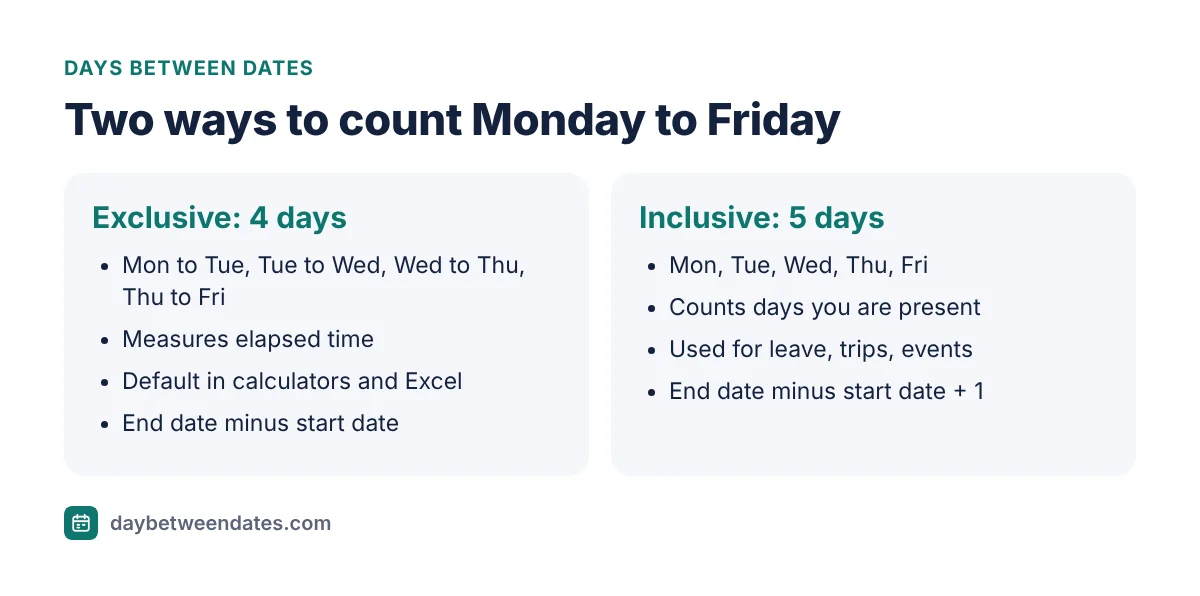
You count the days from Monday to Friday and get 4. A friend counts the same week and gets 5. You are both right. The difference is whether the start and end dates are included in the count, and it is the single most common reason two day counts disagree.
This article explains the two methods, when each one is used, and how to switch between them in a calculator, a spreadsheet or your head. For the full picture of day counting, see our main guide on how to calculate days between two dates.
Exclusive counting: measuring the gap
An exclusive count measures the time that passes between two dates. Think of a ruler: from the 1 mark to the 5 mark is 4 units, not 5. In the same way, from Monday to Friday is 4 days of elapsed time.
This is the standard used by:
- date calculators, including our days between dates calculator by default
- Excel and Google Sheets when you subtract one date from another
- programming languages such as Python, JavaScript and SQL
- ages, anniversaries and "how long ago" questions
The formula is simply: end date − start date.
Inclusive counting: counting every day touched
An inclusive count includes both the first and the last date. It answers "on how many different days does this happen?" rather than "how much time passes?". From Monday to Friday you are at work on 5 separate days, so a leave form asks for 5 days.
The formula is: end date − start date + 1.
When each count is used
Most confusion disappears once you know which situations use which method.
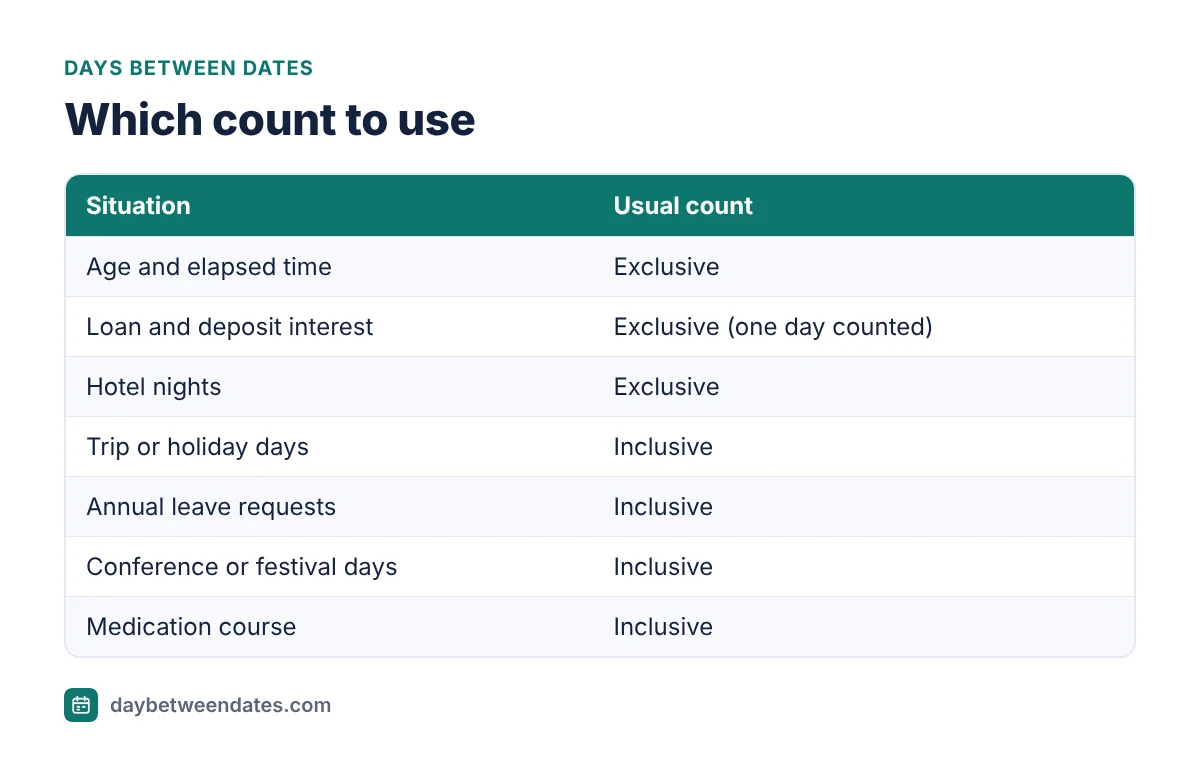
Some examples in practice:
- Hotels charge by nights. Check in on the 10th and check out on the 14th and you pay for 4 nights, the exclusive count.
- Trips are often described in days. The same stay from the 10th to the 14th is a 5 day trip, the inclusive count.
- Annual leave is usually counted inclusively, but weekends and public holidays inside the period are not charged.
- A 7 day course of medicine started on Monday morning ends on Sunday, 7 calendar days counted inclusively.
- Interest on deposits usually counts the day money arrives but not the day it leaves, which works out the same as an exclusive count.
What about legal deadlines?
Many legal systems use a rule that sounds like exclusive counting: exclude the day of the event that starts the period, and include the last day. In the United States, Rule 6 of the Federal Rules of Civil Procedure works this way, and if the last day falls on a weekend or legal holiday, the period runs until the next working day. Many state and national rules are similar, but details differ.
Because the consequences of missing a legal deadline are serious, always read the exact rule that applies to you or ask a qualified professional. Do not rely on a general day count alone.
How to switch between the two
Converting is always a matter of one day:
| You have | You want | Do this |
|---|---|---|
| Exclusive count | Inclusive count | Add 1 |
| Inclusive count | Exclusive count | Subtract 1 |
| Start date and inclusive length | End date | Add the length, then subtract 1 day |
| Start date and exclusive length | End date | Add the length |
So a 30 day inclusive period starting on June 1 ends on June 30, while a period of 30 days of elapsed time starting on June 1 ends on July 1.
In Excel, plain subtraction (=B2-A2) is exclusive, so write =B2-A2+1 for an inclusive count. Be careful with NETWORKDAYS: it already includes both end dates when they are weekdays, so do not add one again.
A quick test to know which you need
Ask yourself one question: am I counting time that passes, or days on which something happens?
- Time that passes (age, waiting period, interest, nights) → exclusive.
- Days on which something happens (work days, event days, trip days, doses) → inclusive.
If the period is written in a contract or policy, the wording wins. Phrases like "from and including" or "through" signal an inclusive count. Phrases like "after", "from the date of" or "within X days of" usually mean the start date is excluded.
Get the right count every time
Inclusive and exclusive counts are both correct answers to different questions, and they always differ by exactly one day. Decide which question you are asking before you count, and you will never be one day off again. Open the days between dates calculator, tick the include end date option when you need an inclusive count, and see both numbers side by side.
More guides in this series
- How to Calculate Days Between Two Dates: The Complete Guide
- How to Count Days Between Two Dates by Hand
- How Many Days Are in Each Month? Table and Memory Tricks
- Leap Years: How They Change Day Counts
Free calculator
Run your own numbers now
Count the days between any two dates in seconds with the free calculator. No sign up, and nothing leaves your browser.