How to Count Days Between Two Dates by Hand
Three simple ways to count the days between two dates without a calculator: the month by month method, the day of year method and counting across years, with worked examples.

Updated 3 min read

In this guide
Calculators are fast, but knowing how to count days by hand helps you check a result, spot errors in a contract or plan a date when you are offline. You only need to know how long each month is and follow a fixed order. This guide shows three methods with full examples.
If you want the background on inclusive counts, leap years and business days, start with the complete guide to calculating days between two dates.
What you need before you start
- The lengths of the months: 31 days for January, March, May, July, August, October and December; 30 days for April, June, September and November; 28 days for February, or 29 in a leap year.
- A decision about the first day. The standard count leaves out the start date. Add one at the end if you need to include it.
Method 1: Month by month
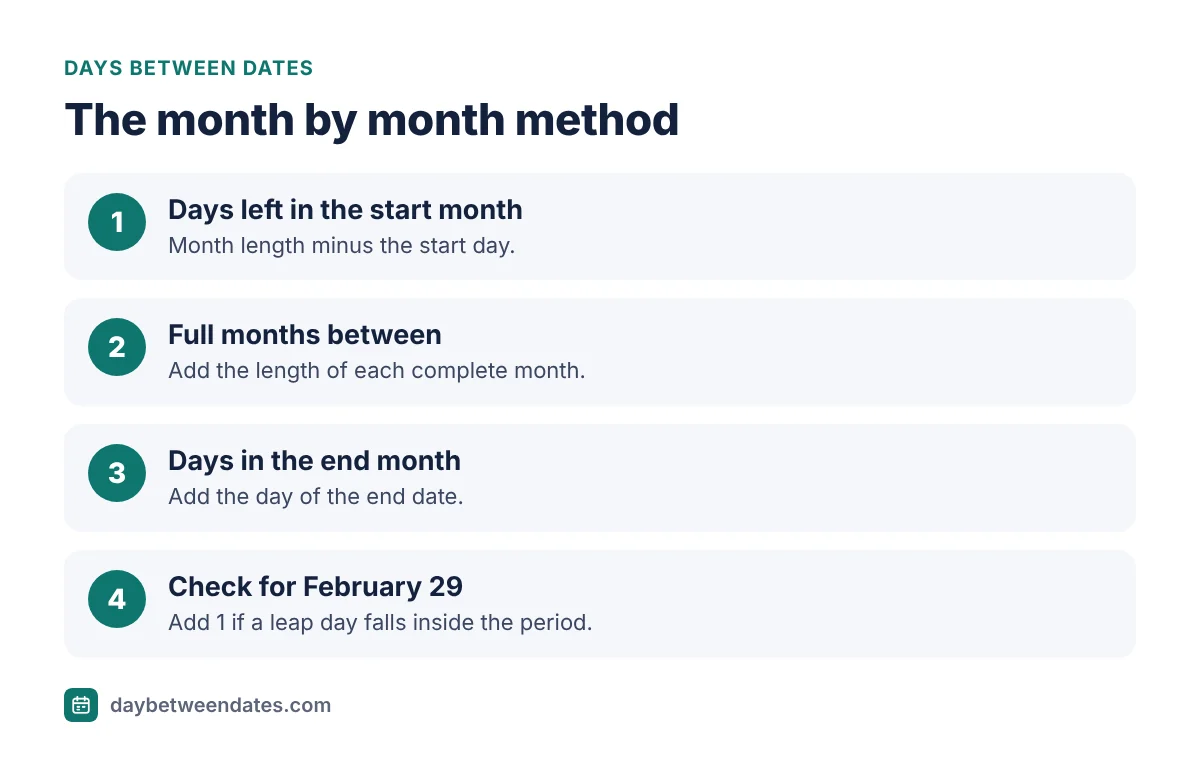
Example: October 3, 2026 to January 20, 2027.
- Days left in October after the 3rd: 31 − 3 = 28.
- Full months in between: November (30) + December (31) = 61.
- Days in January up to the 20th: 20.
- Total: 28 + 61 + 20 = 109 days.
Example within one month: April 6 to April 29. Just subtract: 29 − 6 = 23 days.
Example across one month boundary: May 25 to June 8. Days left in May: 31 − 25 = 6. Add 8 days of June: 6 + 8 = 14 days.
This method is easy to do in your head for short periods, and it shows you exactly where each day comes from.
Method 2: Day of year numbers
Each date has a position in the year. January 1 is day 1 and December 31 is day 365. When both dates fall in the same year, subtract their positions.
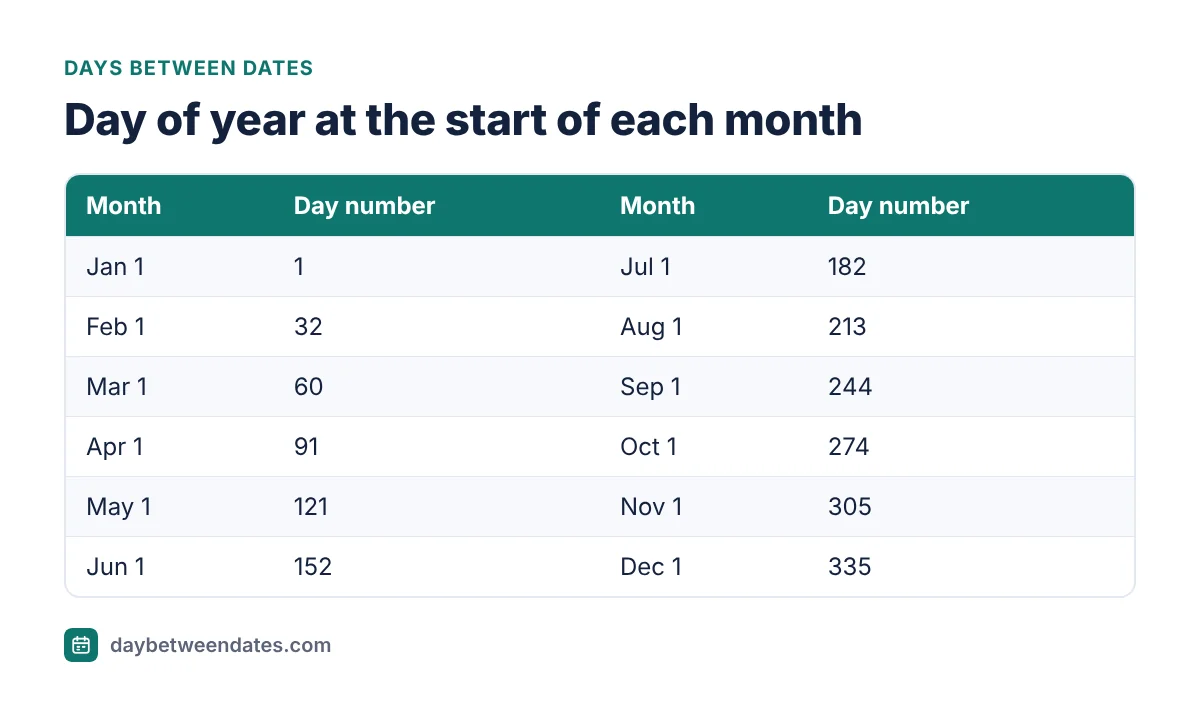
To find a date's number, take the month's starting number, add the day of the month and subtract 1.
Example: February 10 to November 26, 2026.
- February 10 = 32 + 10 − 1 = 41
- November 26 = 305 + 26 − 1 = 330
- Days between = 330 − 41 = 289 days
In a leap year such as 2028, every month from March onward starts one day later, so November 26, 2028 is day 331.
Method 3: Across several years
For long periods, work in whole years first, then finish with one of the methods above.
Example: June 1, 2023 to September 15, 2026.
- June 1, 2023 to June 1, 2024 contains February 29, 2024, so it is 366 days.
- June 1, 2024 to June 1, 2025 is 365 days.
- June 1, 2025 to June 1, 2026 is 365 days.
- June 1 to September 15, 2026: 29 days left in June, 31 in July, 31 in August and 15 in September, for 106 days.
- Total: 366 + 365 + 365 + 106 = 1,202 days.
The rule for each full year: if February 29 falls inside it, the year has 366 days. Our guide to leap years shows how to tell quickly.
How to check your answer
- Count weeks: divide your answer by 7. If you know the two dates fall on the same weekday, the answer must be a multiple of 7.
- Cross check with a second method: if the month by month result and the day of year result agree, you can trust it.
- Use a calculator once: a single check with our days between dates calculator catches any slip.
Common hand counting slips
- Counting the start day in step 1 by accident (use month length minus start day, not plus one).
- Giving every month 30 days.
- Forgetting that February changes in leap years.
- Adding the end month's full length instead of only the days used.
Count by hand, confirm in a click
Hand counting is a useful skill and a great way to sanity check important dates. For anything that affects money, travel or deadlines, confirm your result with the free days between dates calculator, which also shows weeks, months and working days.
More guides in this series
- How to Calculate Days Between Two Dates: The Complete Guide
- How Many Days Are in Each Month? Table and Memory Tricks
- Leap Years: How They Change Day Counts
- How to Find Years, Months and Days Between Two Dates
Free calculator
Run your own numbers now
Count the days between any two dates in seconds with the free calculator. No sign up, and nothing leaves your browser.