Leap Years: How They Change Day Counts
How leap years work, which years are leap years, how many days a leap year has and how February 29 changes the number of days between two dates.

Updated 3 min read

In this guide
Every four years or so, February gets a 29th day and the year grows from 365 to 366 days. That one extra day is easy to forget, and it is a common reason why a day count comes out one short. This guide explains the leap year rule and exactly when February 29 changes the number of days between two dates.
How many days are in a leap year?
A leap year has 366 days. A normal year has 365 days. The difference is February 29, sometimes called leap day.
Why we have leap years
The Earth takes about 365.2422 days to orbit the Sun. A calendar of exactly 365 days would drift by almost a quarter of a day each year, so over a century the seasons would shift by about 24 days. Adding a day roughly every four years keeps the calendar aligned with the seasons.
The leap year rule
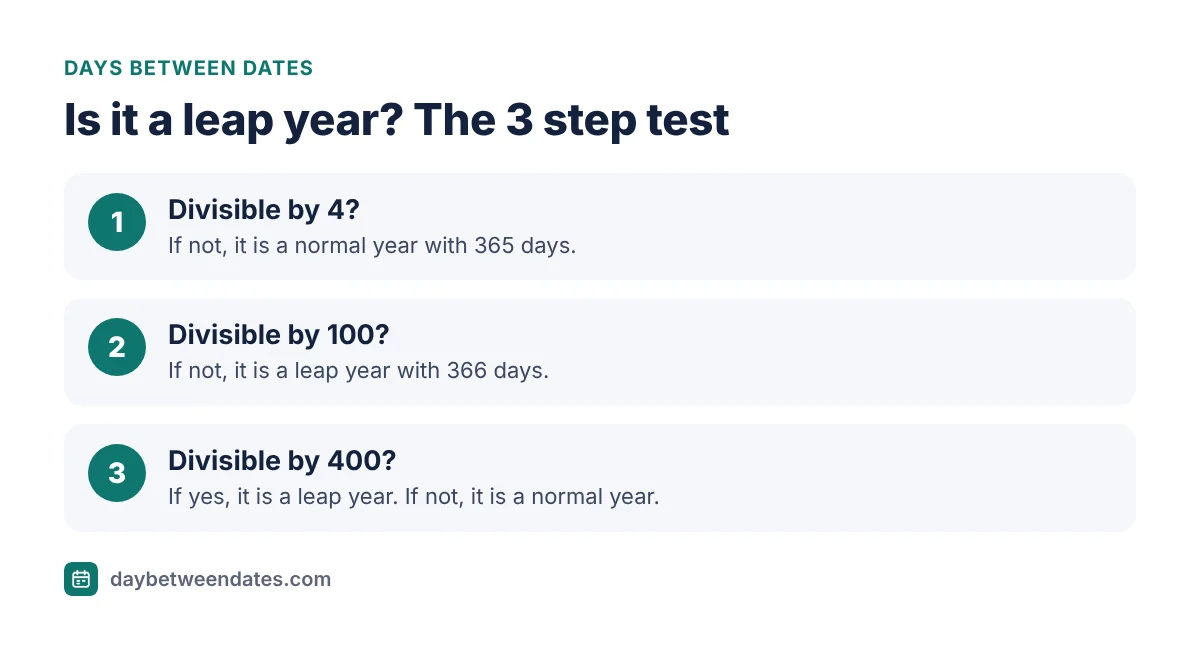
The Gregorian calendar, used almost everywhere today, has three parts to the rule:
- A year divisible by 4 is a leap year (2024, 2028).
- But a year divisible by 100 is not (1900, 2100).
- Unless it is also divisible by 400, in which case it is (2000, 2400).
That is why 2000 was a leap year but 1900 was not, and why 2100 will not be one. These century exceptions make the average year 365.2425 days long, very close to the real value.

When a leap year changes your day count
A leap year only matters if February 29 falls inside the period you are counting.
| Period | Normal year | Leap year |
|---|---|---|
| Jan 1 to Mar 1 | 59 days (2026) | 60 days (2028) |
| Feb 1 to Mar 1 | 28 days (2026) | 29 days (2028) |
| Mar 1 to Dec 31 | 305 days | 305 days |
| Jan 1 to next Jan 1 | 365 days | 366 days |
A period from March 1 to December 31 is the same length in every year, because February is already over.
For one year periods that do not start on January 1, the question is whether a February 29 sits between the two dates. October 1, 2023 to October 1, 2024 is 366 days, because it contains February 29, 2024. October 1, 2024 to October 1, 2025 is 365 days.
Counting leap days over long periods
For long spans such as ages, count how many February 29 dates fall between the start and end. Someone born on May 14, 1990 is 13,149 days old on May 14, 2026: 36 years of 365 days is 13,140, plus 9 leap days (1992, 1996, 2000, 2004, 2008, 2012, 2016, 2020 and 2024).
Leap day birthdays and deadlines
- Birthdays on February 29 are usually marked on February 28 or March 1 in non leap years. Legal treatment varies by country.
- Contracts and subscriptions with an anniversary on February 29 need a rule for normal years. Many systems move to February 28.
- Monthly payments due on the 29th, 30th or 31st usually fall on the last day of shorter months.
Let a calculator handle leap years
Spreadsheets, programming languages and our days between dates calculator apply the leap year rule automatically, so you never have to check for February 29 yourself. For the full method of counting days, including inclusive counts and business days, read how to calculate days between two dates, or see how many days are in each month for the month lengths.
Count days with leap years handled for you
Leap years add one day to any period that includes February 29, and that day matters for ages, interest and deadlines. Use the free days between dates calculator to count any two dates with every leap day already included.
More guides in this series
- How to Calculate Days Between Two Dates: The Complete Guide
- How to Find Years, Months and Days Between Two Dates
- How Many Weeks Between Two Dates?
- What Date Is 30, 60 or 90 Days From Today?
Free calculator
Run your own numbers now
Count the days between any two dates in seconds with the free calculator. No sign up, and nothing leaves your browser.


