Business Days Between Two Dates: How to Count Working Days
How to count the business days between two dates: the weekday method, holidays, inclusive counting, worked examples, Excel NETWORKDAYS, and US, UK, Canada and Australia rules.

Updated 16 min read
In this guide
- The short answer
- What counts as a business day?
- Method 1: count full weeks first
- Method 2: subtract weekends from calendar days
- Handling public holidays
- Should you count the start and end date?
- Adding business days to a date
- How long is 3 to 5 business days?
- Business days vs calendar days
- How many working days are in a year?
- Business days in the UK, Canada and Australia
- Business days in Excel and Google Sheets
- Business days in code
- Worked examples
- Common mistakes
- Tips for planning with business days
- Day of the year numbers
- Business days and leap years
- Business days across time zones
- Where business days show up in daily life
- Partial business days and cutoff times
- Half days and shortened hours
- Business days for different industries
- Counting business days across a year end
- Checking your answer
- Business days and pay periods
- Counting business days in project plans
- US working days per month in 2026
- Counting business days on a paper calendar
- Business days for payments
- Business day vocabulary
- Five questions to ask before you count
- A full worked example from start to finish
- Frequently asked questions
- Count business days in seconds
Shipping estimates, bank transfers, legal notices, payroll and project plans all run on business days, not calendar days. Count the wrong kind of day and a "10 day" deadline can arrive a week earlier than you planned, or a refund window can close before you notice.
This guide explains exactly how to count the business days between two dates: what counts as a business day, the quick weekday method, how to handle public holidays, whether to include the first and last day, and how to do it in Excel and Google Sheets. You can check every example with our days between dates calculator, which has a business days mode.
The short answer
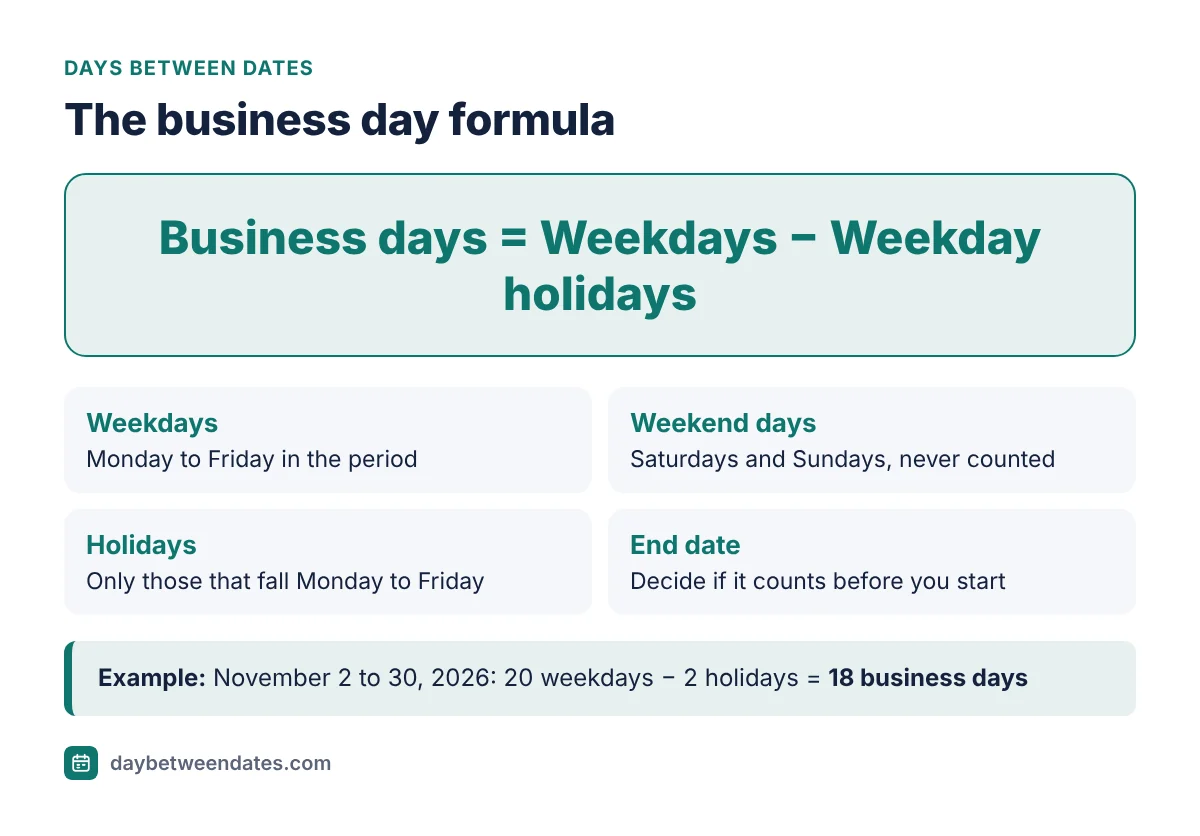
To count business days between two dates, count the weekdays (Monday to Friday) in the period and subtract any public holidays that fall on a weekday.
Business days = weekdays − weekday holidays
For example, from Monday, November 2, 2026 to Monday, November 30, 2026 there are 20 weekdays before November 30. Two US federal holidays fall on weekdays in that window: Veterans Day (Wednesday, November 11) and Thanksgiving (Thursday, November 26). That leaves 18 business days, or 19 if you also count November 30 itself.
What counts as a business day?
A business day is a standard working day: in most countries, Monday through Friday, excluding public holidays. Saturdays and Sundays are not business days, and neither are national holidays on which banks and government offices close.
A few details matter:
- Banking days follow the same idea, but they depend on the bank's own holiday calendar. In the US this usually matches the Federal Reserve holiday schedule.
- Weekend rules differ around the world. In the UAE, the working week is Monday to Friday, but in some other countries the weekend falls on Friday and Saturday.
- Individual companies can set their own working days. A shop open on Saturdays may treat Saturday as a working day for its own deliveries.
For a closer look at the definition, read what counts as a business day.
Method 1: count full weeks first
The fastest way to count business days by hand is to work in whole weeks.
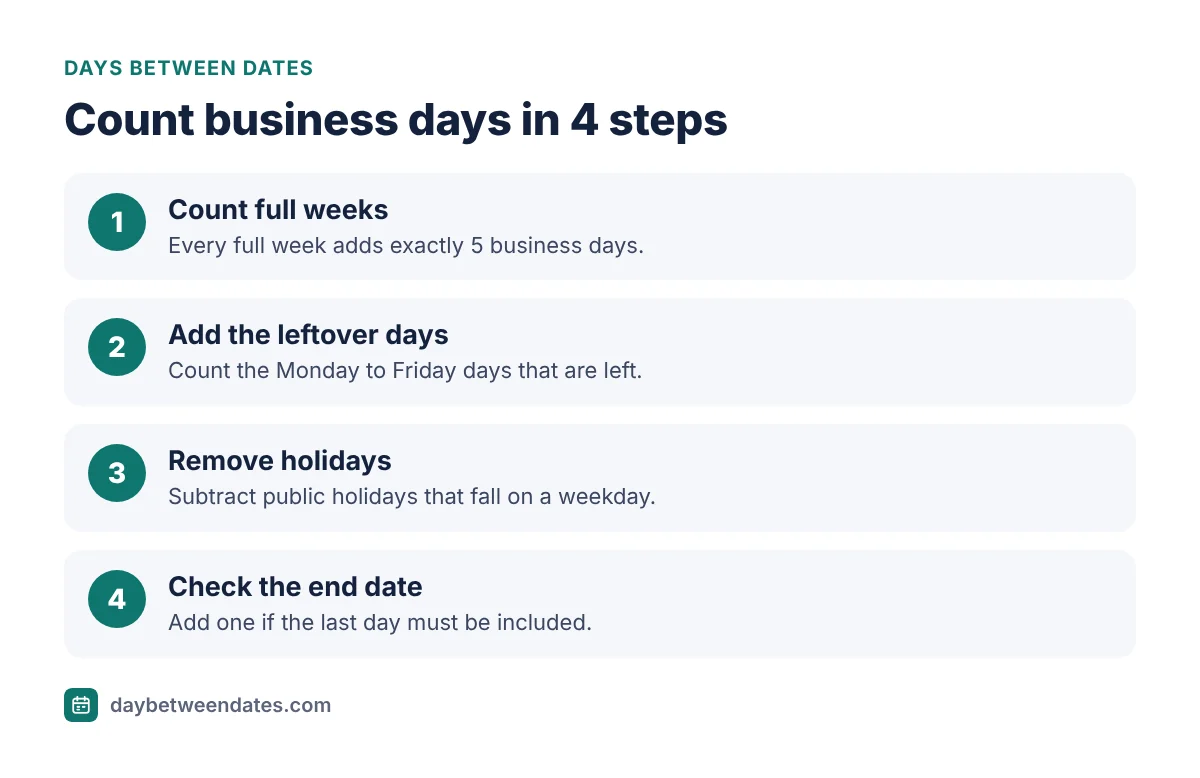
- Count the full weeks between the two dates. Each full week contains exactly 5 business days.
- Count the leftover days at the end that fall Monday to Friday.
- Subtract holidays that fall on a weekday inside the period.
- Decide about the end date. Most calculators count from the start date up to, but not including, the end date. Add one day if the end date is a business day and you need to include it.
Worked example
How many business days are there from Monday, March 2, 2026 to Friday, March 27, 2026, counting both dates?
- From March 2 to March 27 there are 3 full weeks (March 2 to 20), which gives 15 business days.
- The leftover days, March 23 to 27, are Monday to Friday: 5 more business days.
- There are no US federal holidays in March.
- Total: 20 business days.
Method 2: subtract weekends from calendar days
If you already know the number of calendar days, you can work backward:
- Count the calendar days in the period.
- Count the Saturdays and Sundays and subtract them.
- Subtract holidays that fall on a weekday.
This method is useful when the period starts or ends in the middle of a week and you want a quick check. Use our calculator to get the calendar days first, then remove weekends. For a full guide to calendar day counts, read how to calculate days between two dates.
Handling public holidays
Holidays are where most business day counts go wrong. Three rules help:
- Use the right list. US federal holidays, UK bank holidays, Canadian statutory holidays and Australian public holidays are all different, and some vary by state or province.
- Only weekday holidays matter. A holiday on a Saturday or Sunday does not remove a business day, unless it is moved to a weekday.
- Watch observed dates. When a US federal holiday falls on a Saturday, it is usually observed on the Friday before. When it falls on a Sunday, it is observed on the Monday after. In 2026, Independence Day (Saturday, July 4) is observed on Friday, July 3.
US federal holidays
There are 11 permanent US federal holidays: New Year's Day, Martin Luther King Jr. Day, Presidents' Day (officially Washington's Birthday), Memorial Day, Juneteenth, Independence Day, Labor Day, Columbus Day, Veterans Day, Thanksgiving and Christmas. Inauguration Day is an extra holiday every four years for federal employees in the Washington, DC area.
| Holiday | 2026 | 2027 |
|---|---|---|
| New Year's Day | Thu, Jan 1 | Fri, Jan 1 |
| Martin Luther King Jr. Day | Mon, Jan 19 | Mon, Jan 18 |
| Presidents' Day | Mon, Feb 16 | Mon, Feb 15 |
| Memorial Day | Mon, May 25 | Mon, May 31 |
| Juneteenth | Fri, Jun 19 | Fri, Jun 18 (observed) |
| Independence Day | Fri, Jul 3 (observed) | Mon, Jul 5 (observed) |
| Labor Day | Mon, Sep 7 | Mon, Sep 6 |
| Columbus Day | Mon, Oct 12 | Mon, Oct 11 |
| Veterans Day | Wed, Nov 11 | Thu, Nov 11 |
| Thanksgiving | Thu, Nov 26 | Thu, Nov 25 |
| Christmas Day | Fri, Dec 25 | Fri, Dec 24 (observed) |
Private businesses do not have to close on every federal holiday, and many stay open on Columbus Day and Veterans Day. Banks generally follow the Federal Reserve schedule. More detail is in US federal holidays and business day counts.
Should you count the start and end date?
This is the same question as for calendar days, and it changes the answer by one.
- Default (exclusive end): most calculators and spreadsheet functions that subtract dates count from the start date up to the end date, so a Monday to Friday span gives 4 days.
- Both dates included: Excel's NETWORKDAYS function counts both the start and end date if they are business days, so Monday to Friday gives 5.
- Deadlines stated as "within X business days" usually start counting the day after the triggering event. If an order is placed on Monday, day 1 is Tuesday.
Always check which convention a contract, bank or shipping company uses. Our guide to inclusive and exclusive day counts explains the difference in detail.
Adding business days to a date
Often you do not need the number of business days between two dates, but the date that falls a certain number of business days later. For example, 10 business days from Monday, December 14, 2026 is Tuesday, December 29, 2026, because Christmas Day (Friday, December 25) is skipped along with two weekends.
| Start date | Business days | Result |
|---|---|---|
| Mon, Nov 23, 2026 | 10 | Tue, Dec 8, 2026 |
| Mon, Dec 14, 2026 | 10 | Tue, Dec 29, 2026 |
| Mon, Mar 1, 2027 | 10 | Mon, Mar 15, 2027 |
| Mon, Mar 1, 2027 | 30 | Mon, Apr 12, 2027 |
| Mon, Mar 1, 2027 | 45 | Mon, May 3, 2027 |
These results assume US federal holidays and that the start date itself is not counted. Read 10, 30 and 45 business days from a date for more examples.
How long is 3 to 5 business days?
Shipping and refund messages often promise delivery in "3 to 5 business days". If you order on a Thursday, 3 business days usually means the following Tuesday, and 5 business days means the following Thursday, as long as there are no holidays. Over Thanksgiving week, an order placed on Thursday, November 19, 2026 would take until Friday, November 27 for 5 business days, because Thanksgiving is skipped. See how long 3 to 5 business days takes.
Business days vs calendar days
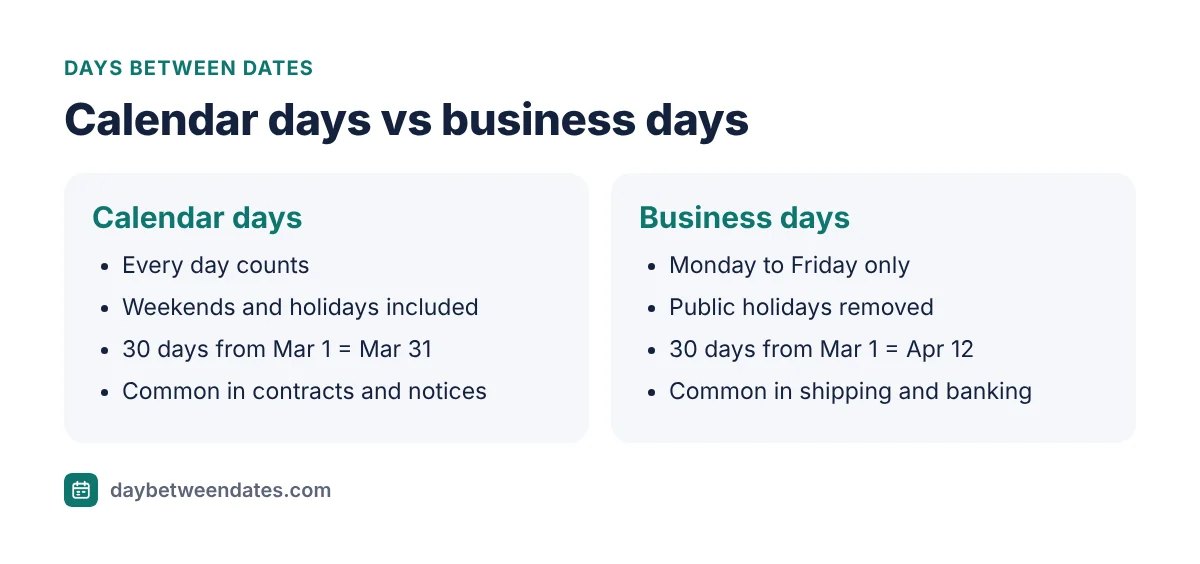
Legal and contractual deadlines are often stated in calendar days, while banks, couriers and government agencies tend to use business days. The difference adds up quickly: 30 calendar days from March 1, 2027 is March 31, but 30 business days is April 12. When a document only says "days", look for a definition section. For a full comparison, read business days vs calendar days.
How many working days are in a year?
A normal year has 52 weeks and 1 or 2 extra days, which gives 260 or 261 weekdays. In the US, subtracting the 11 federal holidays leaves about 250 working days. In 2026 and 2027 there are 261 weekdays and 250 federal working days.
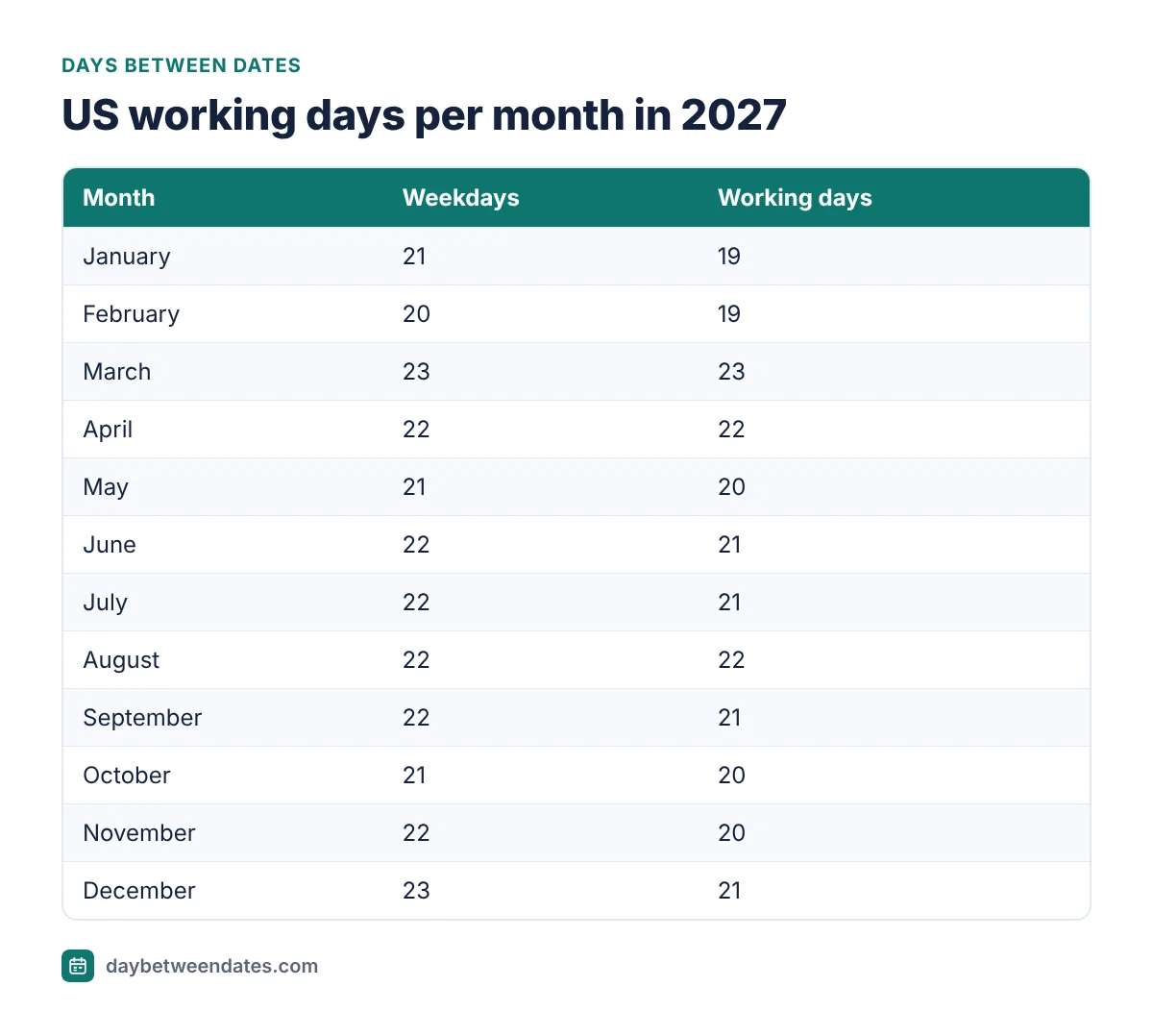
Your own number will be lower once you subtract paid time off. Someone with 15 days of vacation would work around 235 days in 2027. The full breakdown is in how many working days are in a year.
Business days in the UK, Canada and Australia
The method is the same everywhere, but the holiday list changes:
| Country | Typical public holidays | Notes |
|---|---|---|
| United States | 11 federal holidays | Many states add their own |
| England and Wales | 8 bank holidays | Scotland has 9, Northern Ireland 10 |
| Canada | 5 to 6 national holidays | Each province adds its own statutory holidays |
| Australia | 7 national public holidays | Each state and territory adds more |
In England and Wales, 2027 has 261 weekdays and 8 bank holidays, so there are 253 working days. Details for each country are in working days in the UK, Canada and Australia.
Business days in Excel and Google Sheets
Spreadsheets have built in functions for business days.
| Task | Formula |
|---|---|
| Business days between A2 and B2, both included | =NETWORKDAYS(A2,B2) |
| Same, with a holiday list in H2:H12 | =NETWORKDAYS(A2,B2,H2:H12) |
| Custom weekend, for example Friday and Saturday | =NETWORKDAYS.INTL(A2,B2,7) |
| Date 10 business days after A2 | =WORKDAY(A2,10,H2:H12) |
| Date 10 business days before A2 | =WORKDAY(A2,-10,H2:H12) |
Two things to remember:
- NETWORKDAYS includes both dates. Subtract 1 if you want the start date excluded.
- WORKDAY does not count the start date. WORKDAY(Monday, 1) returns Tuesday.
Google Sheets uses the same function names. Keep your holiday list on a separate tab so you can update it every year.
Business days in code
Most programming languages have libraries for business days:
- Python:
numpy.busday_count(start, end, holidays=[...])counts business days from the start date up to, but not including, the end date.numpy.busday_offsetadds business days to a date. - JavaScript: there is no built in function, so most developers loop through the dates or use a date library and skip Saturdays, Sundays and holidays.
- SQL: a calendar table with one row per date and a flag for business days is the most reliable approach.
Whatever the language, store holidays as a list you can update, rather than hard coding them.
Worked examples
Example 1: a 30 day payment term in business days. An invoice dated Monday, January 4, 2027 is due in 30 business days. Skipping weekends, Martin Luther King Jr. Day and Presidents' Day, the due date is Wednesday, February 17, 2027.
Example 2: a 45 business day review. A review that starts on Monday, January 4, 2027 and takes 45 business days ends on Wednesday, March 10, 2027.
Example 3: a shipping estimate before Christmas. An order placed on Friday, December 18, 2026 with 5 business day shipping should arrive by Monday, December 28, because Christmas Day is not a business day.
Example 4: counting a month. November 2026 has 21 weekdays, but Veterans Day and Thanksgiving leave 19 working days for US federal offices.
Common mistakes
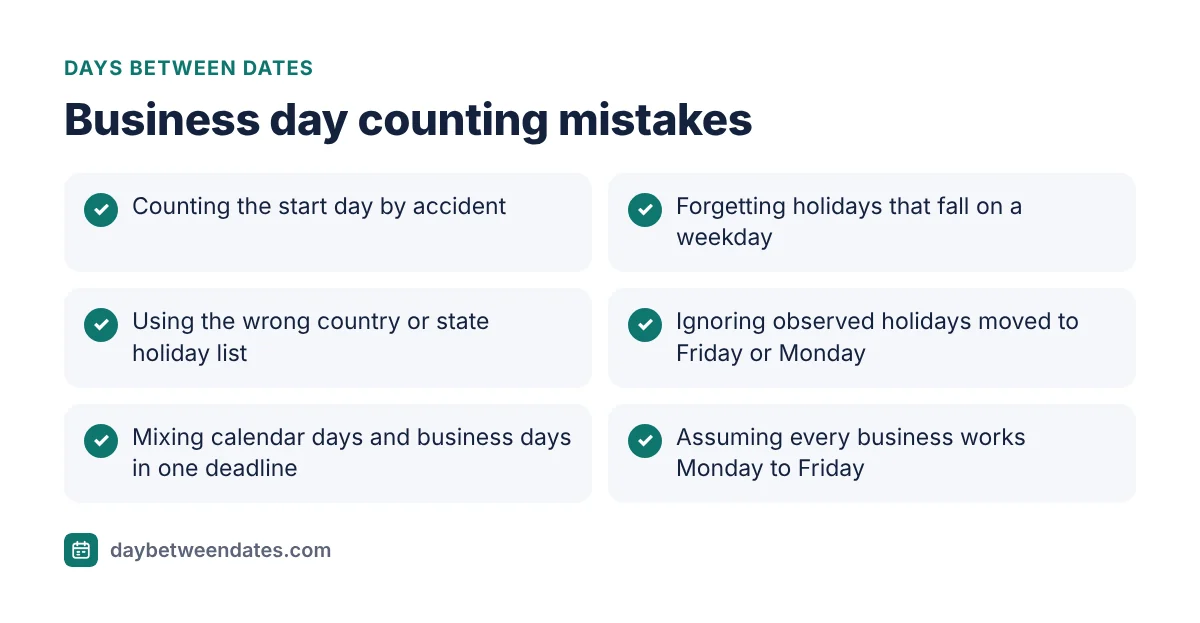
- Counting the start day. "Within 5 business days of Monday" usually ends on the following Monday, not Friday.
- Forgetting moved holidays. In 2027, both Juneteenth and Independence Day are observed on different dates from the calendar date.
- Using another country's calendar. A UK bank holiday does not delay a US transfer, and the reverse.
- Mixing day types. If a contract gives 10 business days to respond but the notice period is 30 calendar days, track both separately.
Tips for planning with business days
- Add a buffer of one or two business days to any deadline that depends on shipping or bank transfers.
- Check the holiday calendar at the start of each year and before long weekends.
- For international work, list the holidays of every country involved.
- Write dates in full in contracts ("Tuesday, December 29, 2026") to avoid confusion between US and international date formats.
Day of the year numbers
Some industries, including logistics and food production, label dates by their day of the year number rather than the calendar date. For example, November 22, 2026 is day 326. This is handy for counting days quickly: subtract one day number from another. Read day of the year numbers to learn how they work.
Business days and leap years
A leap year adds February 29, which can fall on a weekday or a weekend. In 2028, February 29 is a Tuesday, so that year has one extra business day before holidays are taken into account. Always count with the real calendar rather than assuming every year has the same number of working days.
Business days across time zones
When the two parties are in different countries, a business day can start or end at a different moment for each of them. A request sent on Friday afternoon in New York arrives on Saturday morning in Sydney, outside the Australian working week. For international deadlines, agree on whose calendar and whose time zone count, and write it into the agreement, such as "five business days, New York time".
Where business days show up in daily life
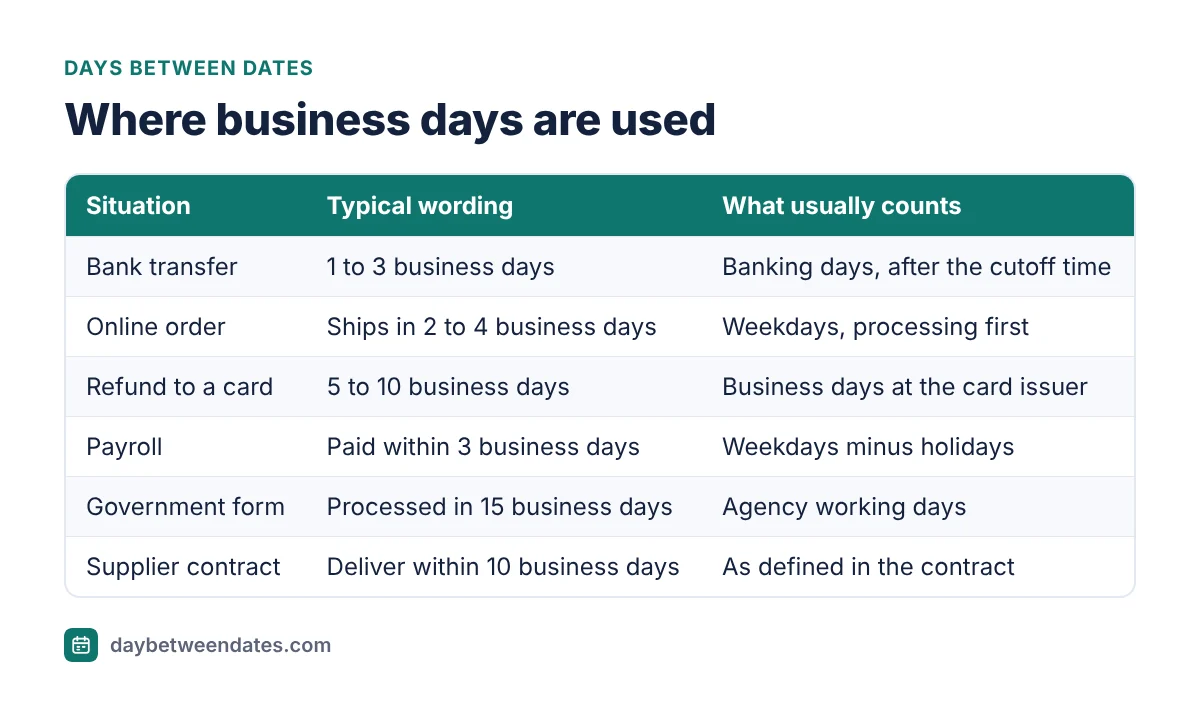
Each of these uses the same basic rule, but the details change. A bank may stop processing payments at 3 p.m., so a transfer made at 4 p.m. on Friday starts on Monday. An online shop may need one or two days to pack an order before the shipping clock starts. Reading the small print tells you which days count and when the count begins.
Partial business days and cutoff times
Many deadlines depend on the time of day as well as the date:
- Bank cutoff times. Payments received after the cutoff are treated as received on the next business day.
- Courier pickup times. An order packed after the last pickup leaves the next business day.
- Office closing times. A form submitted at 6 p.m. may be logged on the next business day.
- Time zones. A business day in New York ends three hours before a business day in Los Angeles, and long before one in Sydney begins.
If a deadline is tight, assume the count starts on the next business day and plan around it.
Half days and shortened hours
Some days are not full public holidays but are shorter working days. In the US, many offices close early on the day before Thanksgiving or Christmas Eve, and US stock markets close early on certain days. In the UK, many offices close early on Christmas Eve. These days still usually count as business days, but they may not be useful for processing requests.
Business days for different industries
| Industry | Common working week | Notes |
|---|---|---|
| Banking | Monday to Friday | Follows the central bank holiday calendar |
| Retail | Seven days | Deliveries and returns still use business days |
| Healthcare | Seven days | Admin offices usually work Monday to Friday |
| Government | Monday to Friday | Closed on all public holidays |
| Manufacturing | Often Monday to Friday | Some plants run shifts every day |
| Stock markets | Monday to Friday | Closed on exchange holidays, which differ from federal holidays |
When a company says "business days", it usually means its own working days. A retailer open on Saturday may still quote delivery in Monday to Friday business days because the carrier does not deliver on weekends.
Counting business days across a year end
The holiday season is where business day counts get tricky. Between Christmas and New Year, there are usually two holidays within eight days. For example, from Monday, December 21, 2026 to Monday, January 4, 2027:
- There are 10 weekdays from December 21 to January 1.
- Christmas Day (Friday, December 25) and New Year's Day (Friday, January 1) are holidays.
- That leaves 8 business days before January 4.
Many businesses also close for the whole week between the holidays, which reduces the real working time even further. Ask suppliers about their holiday closures well before December.
Checking your answer
To be confident in a business day count:
- Count the calendar days with a calculator.
- Check the count of full weeks: every 7 calendar days contain exactly 5 weekdays.
- List every holiday in the period and confirm it falls on a weekday.
- Recount the last partial week by hand.
- Compare with a spreadsheet using NETWORKDAYS.
If two methods agree, you can trust the result.
Business days and pay periods
Payroll teams use business days to set pay dates and deadlines:
- A biweekly pay period always contains 10 weekdays, but holidays can reduce the number of working days.
- A semi monthly pay period (the 1st to the 15th and the 16th to the end of the month) contains 10 to 12 weekdays.
- When a payday falls on a weekend or holiday, employers usually pay on the business day before.
For example, if payday is the 15th and January 15, 2028 is a Saturday, staff would usually be paid on Friday, January 14.
Counting business days in project plans
Project managers schedule tasks in working days, not calendar days. A task estimated at 15 working days that starts on a Monday ends on the Friday two weeks later, three full weeks if there are no holidays. Most project tools let you set a working calendar with holidays, so dates move automatically when holidays fall inside a task.
Keep in mind that people take leave, so a team of five with 15 working days each does not always deliver 75 days of work. Plan a buffer of around 10 percent for leave and sick days in longer projects.
US working days per month in 2026
If you are planning the rest of this year, here are the 2026 totals for US federal offices:
| Month | Weekdays | Working days |
|---|---|---|
| January | 22 | 20 |
| February | 20 | 19 |
| March | 22 | 22 |
| April | 22 | 22 |
| May | 21 | 20 |
| June | 22 | 21 |
| July | 23 | 22 |
| August | 21 | 21 |
| September | 22 | 21 |
| October | 22 | 21 |
| November | 21 | 19 |
| December | 23 | 22 |
The total is 261 weekdays and 250 working days. November 2026 has the fewest working days because Veterans Day and Thanksgiving both fall on weekdays.
Counting business days on a paper calendar
If you prefer to count by hand, a printed calendar works well:
- Circle the start date and the end date.
- Cross out every Saturday and Sunday between them.
- Cross out every public holiday that falls on a weekday.
- Count the remaining days, leaving out the start date unless your rule includes it.
This method is slow for long periods, but it is the easiest way to see exactly which days count, and it is a good way to double check a calculator result for a short deadline.
Business days for payments
Money moves on business days, and each payment type has its own timing:
- Bank transfers between accounts at the same bank are often instant or same day.
- ACH transfers in the US usually settle within one to two business days, and same day ACH is available for many payments sent before the cutoff time.
- Domestic wire transfers are usually completed the same business day if sent before the cutoff.
- International transfers can take one to five business days, depending on the banks and countries involved, because each country's holidays apply.
- Card refunds often take five to ten business days to appear, because the merchant, the payment network and the card issuer each process the refund.
Payments started on a Friday afternoon or before a long weekend can take noticeably longer in calendar days, even though the number of business days is the same.
Business day vocabulary
- Business day: a working day, usually Monday to Friday, excluding public holidays.
- Banking day: a day on which banks are open to process payments.
- Calendar day: any day of the year, including weekends and holidays.
- Observed holiday: the weekday on which a holiday is taken when the real date falls on a weekend.
- Cutoff time: the latest time of day at which a request is processed on the same business day.
- Working day: often used as a synonym for business day, especially in the UK.
- Turnaround time: the number of business days a company needs to complete a request.
Knowing these terms makes it easier to read delivery promises, contracts and bank notices, and to compare offers from different providers on a fair basis.
Five questions to ask before you count
Before you count business days for anything important, answer these five questions. They prevent almost every mistake.
- Which day starts the count? Is it the day of the event, or the next business day? Most rules start on the next business day.
- Is the last day included? "Within 10 business days" normally includes the tenth business day itself.
- Whose holidays apply? Use the holiday calendar of the country, state or company that sets the deadline.
- Is there a cutoff time? A request received late in the day may count as received the next business day.
- What happens if the deadline falls on a non business day? Some rules move it forward to the next business day, others move it back.
Write the answers next to the deadline in your calendar. If anyone asks later how you arrived at the date, you will have the reasoning ready.
A full worked example from start to finish
A tenant receives a written notice on Wednesday, November 25, 2026. The notice says they have 10 business days to respond. The landlord's lease refers to US federal holidays.
- The count starts the next business day. Thursday, November 26 is Thanksgiving, so day 1 is Friday, November 27.
- The following week, Monday, November 30 to Friday, December 4, adds days 2 to 6.
- Monday, December 7 to Thursday, December 10 add days 7 to 10.
- The response is due by Thursday, December 10, 2026.
If the notice had said 10 calendar days, the deadline would have been Saturday, December 5. That is a difference of five days for the same number in the notice.
This example shows why it pays to check every rule before you rely on a date. Our calculator gives you both counts at once, so you can see the difference immediately and plan for the earlier date when you are unsure.
Frequently asked questions
How many business days are in a week?
Five: Monday, Tuesday, Wednesday, Thursday and Friday, unless a public holiday falls on one of them.
Is Saturday a business day?
No. In most countries Saturday and Sunday are not business days, although some businesses work on Saturdays.
Do business days include holidays?
No. Public holidays that fall on a weekday are excluded from business day counts.
How many business days are in a month?
Usually between 19 and 23, depending on how many weekdays the month has and how many holidays fall on weekdays.
How do I count business days in Excel?
Use =NETWORKDAYS(start, end, holidays). It counts both the start and end date if they are business days.
Count business days in seconds
Now you know how to count business days by hand, deal with holidays and use spreadsheet formulas. For a quick and reliable answer, open our days between dates calculator, switch to business days, and enter your two dates. You will see the business days, the calendar days and the weeks between them instantly.
More guides in this series
- What Counts as a Business Day?
- How Long Is 3 to 5 Business Days?
- 10, 30 and 45 Business Days From a Date
- US Federal Holidays and Business Day Counts
- Business Days vs Calendar Days in Contracts and Deadlines
- How Many Working Days Are in a Year?
- Working Days in the UK, Canada and Australia
- Day of the Year Numbers (Julian Day) Explained
Sources
Free calculator
Run your own numbers now
Count the days between any two dates in seconds with the free calculator. No sign up, and nothing leaves your browser.