Day of the Year Numbers (Julian Day) Explained
What day of the year numbers are, how to calculate them, a month start table for normal and leap years, the Julian date used in industry, and how to count days with them.

Updated 2 min read

In this guide
Some calendars, food labels and logistics systems use a number from 1 to 365 instead of a date. That number is the day of the year, and it makes counting days very quick.
For the general method, read how to calculate days between two dates.
What is a day of the year number?
It is the position of a date in its year. January 1 is day 1, December 31 is day 365, or day 366 in a leap year.
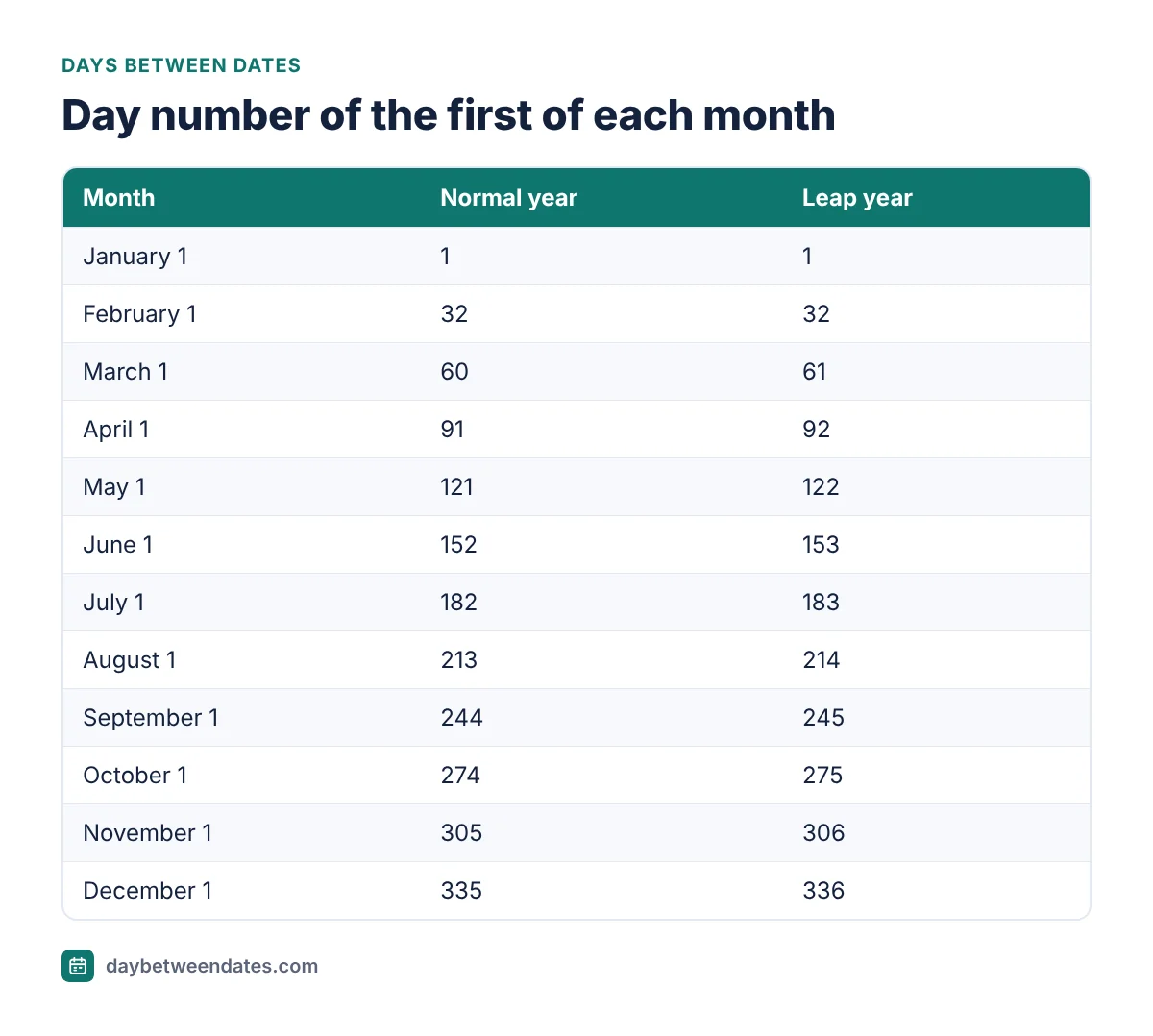
How to calculate it
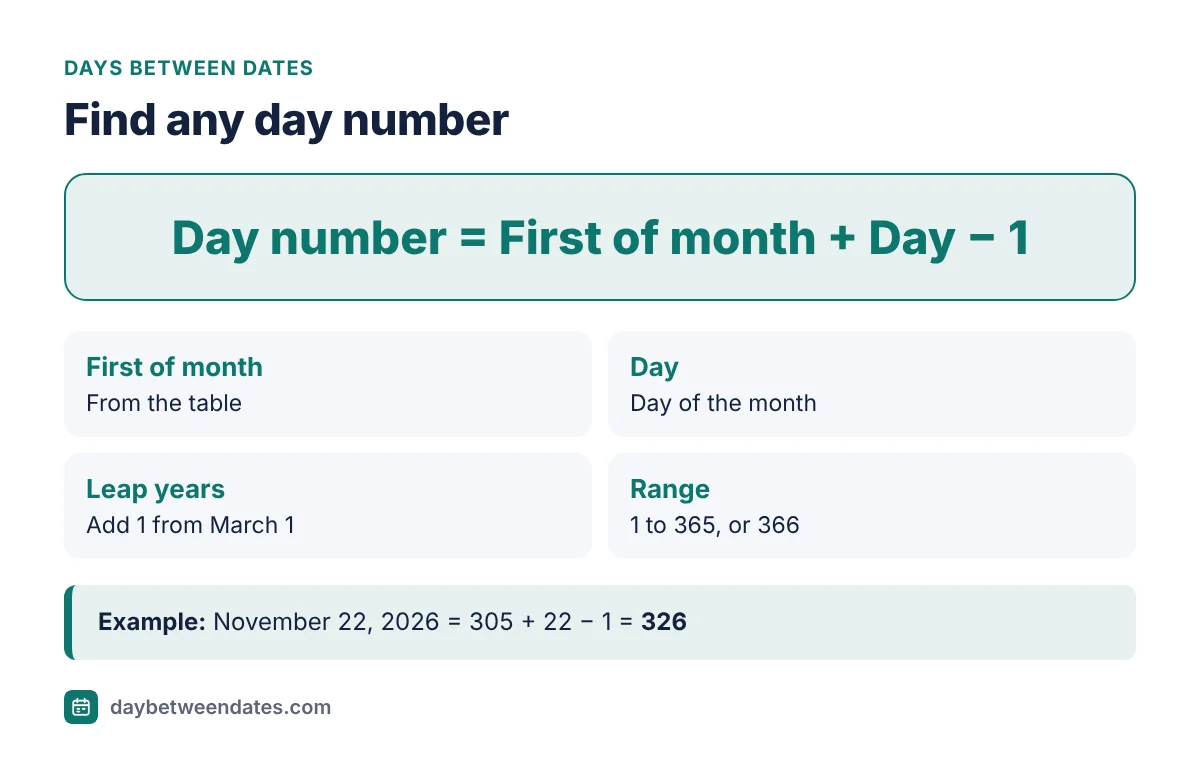
More examples:
- July 4, 2026 is day 185.
- March 15, 2026 is day 74.
- March 1, 2028 is day 61, because 2028 is a leap year.
Counting days with day numbers
Within the same year, subtract the day numbers. From March 15 (day 74) to July 4 (day 185), 2026, there are 185 − 74 = 111 days.
The Julian date in industry
In manufacturing and food production, a "Julian date" code often combines the year and the day number. For example, 26326 can mean 2026, day 326 (November 22). This is not the same as the astronomical Julian Day, which counts days continuously from the year 4713 BC and is used by astronomers.
In spreadsheets
In Excel or Google Sheets, =A2-DATE(YEAR(A2),1,0) returns the day of the year for the date in A2.
Why day numbers are useful
- Quick subtraction. Counting days between two dates in the same year becomes a single subtraction.
- Short codes. Factories print day numbers on packaging because they are shorter than full dates.
- Tracking progress. Day 183 is the middle of a normal year, so you can see at a glance how much of the year has passed.
- Planning. Some teams track goals by day number, for example "100 days" challenges that start on day 1 of the year.
Count days instantly
Our days between dates calculator does the counting for you. To understand which years have 366 days, read leap years and day counts.
More guides in this series
Free calculator
Run your own numbers now
Count the days between any two dates in seconds with the free calculator. No sign up, and nothing leaves your browser.