How Many Days Are in Each Month? Table and Memory Tricks
A clear table of how many days are in each month, why February has 28 or 29 days, and two easy tricks to remember month lengths: the knuckle rule and the rhyme.

Updated 3 min read

In this guide
Knowing how many days are in each month is the foundation of every date calculation, from paying rent on time to counting down to a holiday. Here is the complete list, plus two memory tricks so you never have to look it up again.
Days in each month
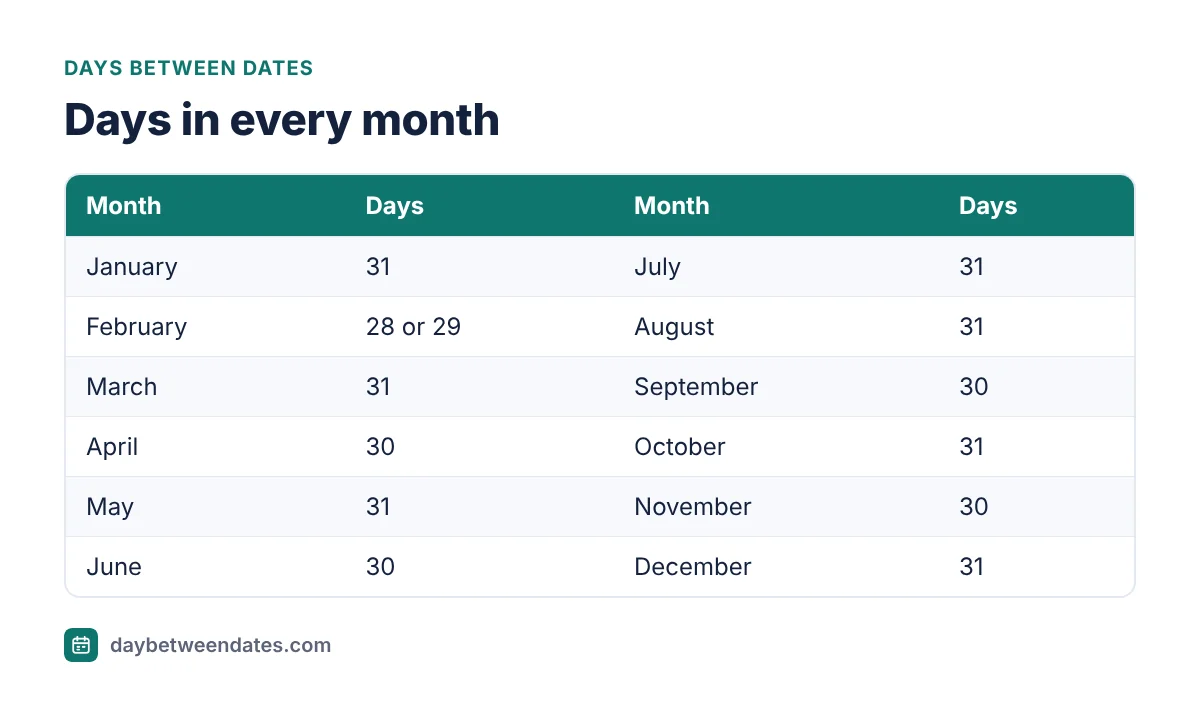
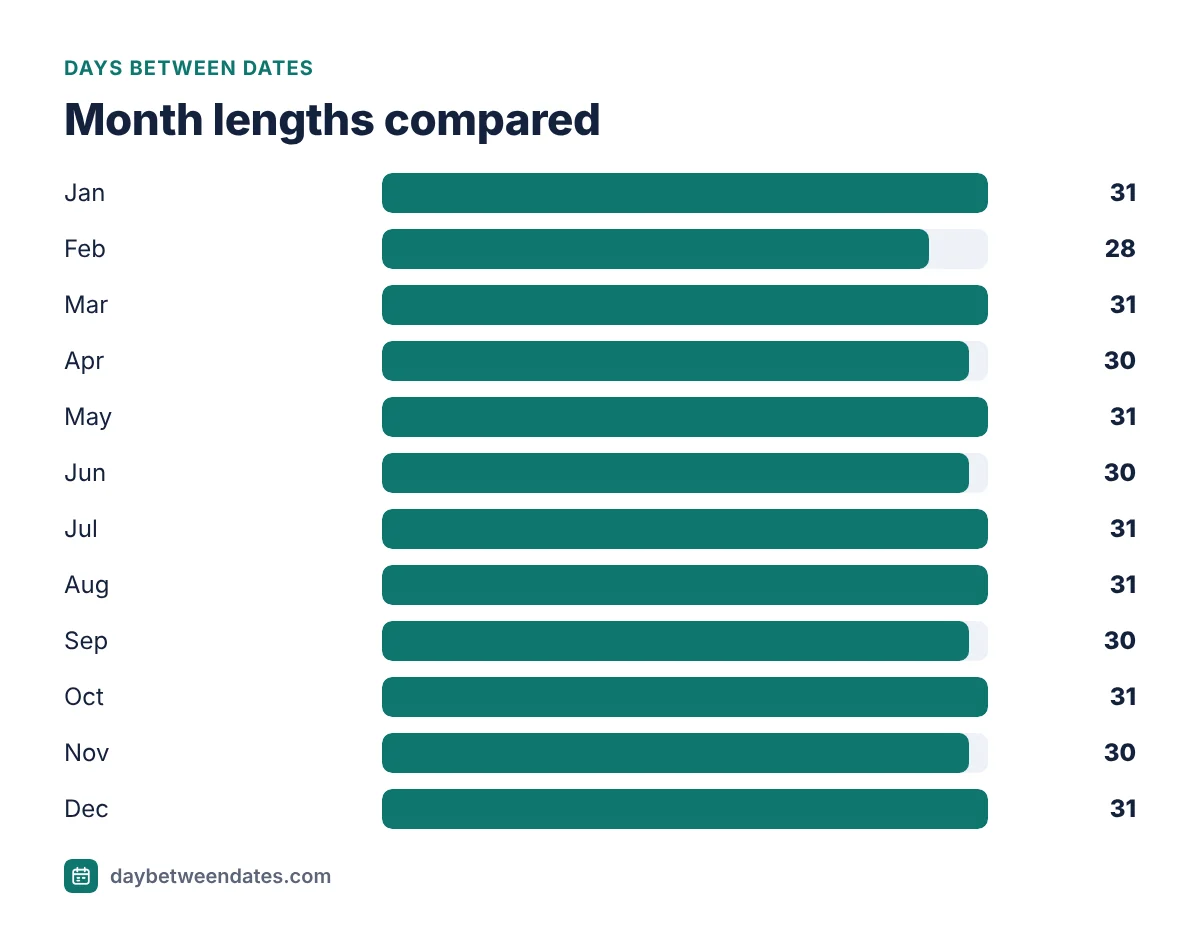
In total, a normal year has 365 days and a leap year has 366. Seven months have 31 days, four months have 30 days, and February has 28 days, or 29 in a leap year.
| Number of days | Months |
|---|---|
| 31 days | January, March, May, July, August, October, December |
| 30 days | April, June, September, November |
| 28 or 29 days | February |
Trick 1: The knuckle rule
Make a fist with one hand and look at your knuckles. Starting with the first knuckle, name the months in order, landing on a knuckle, then the dip between knuckles, then the next knuckle.
- Knuckles are months with 31 days.
- Dips are months with 30 days, or February.
January (knuckle), February (dip), March (knuckle), April (dip), May (knuckle), June (dip), July (last knuckle). Then start again on the first knuckle: August (knuckle), September (dip), October (knuckle), November (dip), December (knuckle).
The trick works because July and August both land on knuckles, which matches the calendar exactly.
Trick 2: The traditional rhyme
A rhyme taught in schools for centuries goes:
Thirty days hath September, April, June and November. All the rest have thirty one, except February alone, which has twenty eight days clear and twenty nine in each leap year.
Remember the four 30 day months, remember February, and every other month has 31 days.
Why are months different lengths?
Our calendar comes from the Roman calendar, which was reformed by Julius Caesar in 46 BC and adjusted again by Pope Gregory XIII in 1582. The aim was to fit 12 months into a solar year of about 365.24 days. Since 12 does not divide 365 evenly, some months got 31 days, some 30, and February, once the last month of the Roman year, was left with the remainder.
Why February has 28 or 29 days
February gets an extra day in leap years to keep the calendar in step with the Earth's orbit. A year is a leap year if it is divisible by 4, except years divisible by 100 unless they are also divisible by 400. So 2024 and 2028 have February 29, while 2026 and 2027 do not. Read more in leap years and day counts.
Using month lengths to count days
Once you know month lengths, you can count the days between any two dates. For example, from April 20 to June 5: 10 days left in April (30 − 20), 31 days in May, and 5 days in June, for 46 days. Our guide on counting days by hand shows the method in detail, and the complete guide covers every way to count days between dates.
Quick facts
- Number of weeks in a month: just over 4 (4 weeks and 2 or 3 days, or exactly 4 weeks for February in a normal year).
- Average month length: about 30.44 days.
- Days in a quarter: 90 (Q1 in a normal year), 91 (Q2) and 92 (Q3 and Q4).
- Days in the first half of a normal year: 181. Second half: 184.
Skip the counting
Month lengths are easy to remember with the knuckle rule, but counting across several months still takes time. Let the free days between dates calculator do it: pick any two dates and get the exact number of days, weeks and months instantly.
More guides in this series
- How to Calculate Days Between Two Dates: The Complete Guide
- Leap Years: How They Change Day Counts
- How to Find Years, Months and Days Between Two Dates
- How Many Weeks Between Two Dates?
Free calculator
Run your own numbers now
Count the days between any two dates in seconds with the free calculator. No sign up, and nothing leaves your browser.